
+12012030360

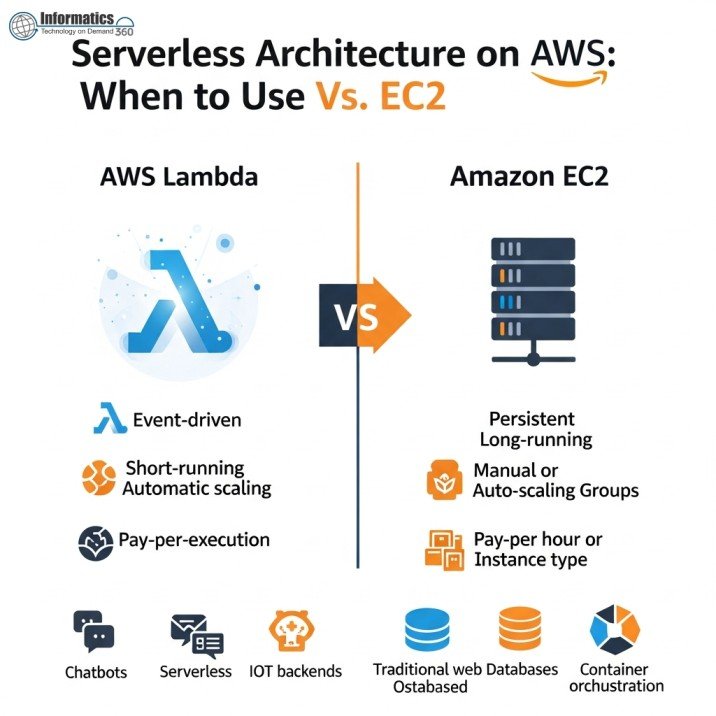
Choosing the right compute service is one of the most critical decisions when building applications on AWS. While both AWS Lambda and EC2 (Elastic Compute Cloud) offer powerful computing capabilities, they serve fundamentally different purposes and use cases. Understanding when to leverage serverless architecture with Lambda versus traditional virtual machines with EC2 can significantly impact your application’s performance, cost-efficiency, and scalability.
Understanding AWS Lambda: The Serverless Approach
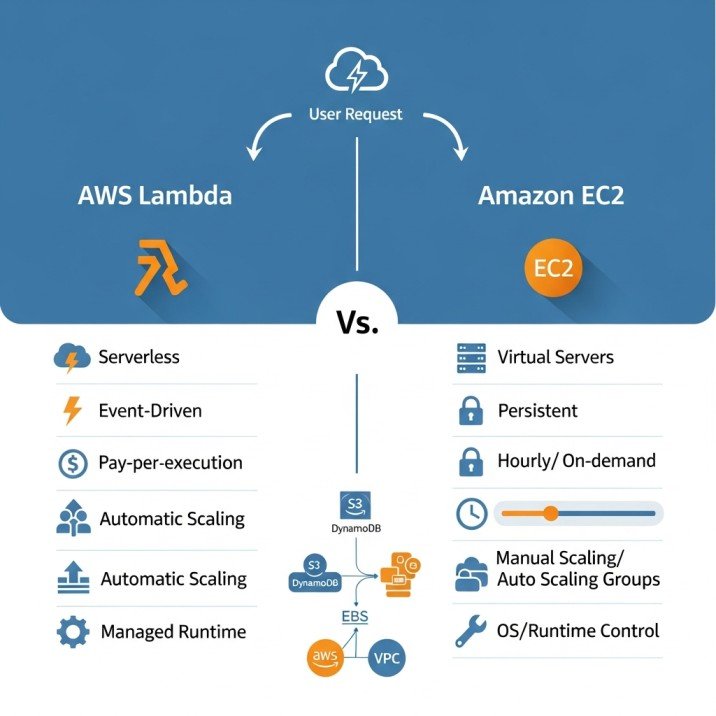
AWS Lambda is a serverless compute service that automatically runs your code in response to events without requiring you to provision or manage servers. With Lambda, you only pay for the compute time you consume, making it an incredibly cost-effective solution for many workloads. The service automatically scales your application by running code in response to each trigger, handling everything from a few requests per day to thousands per second.
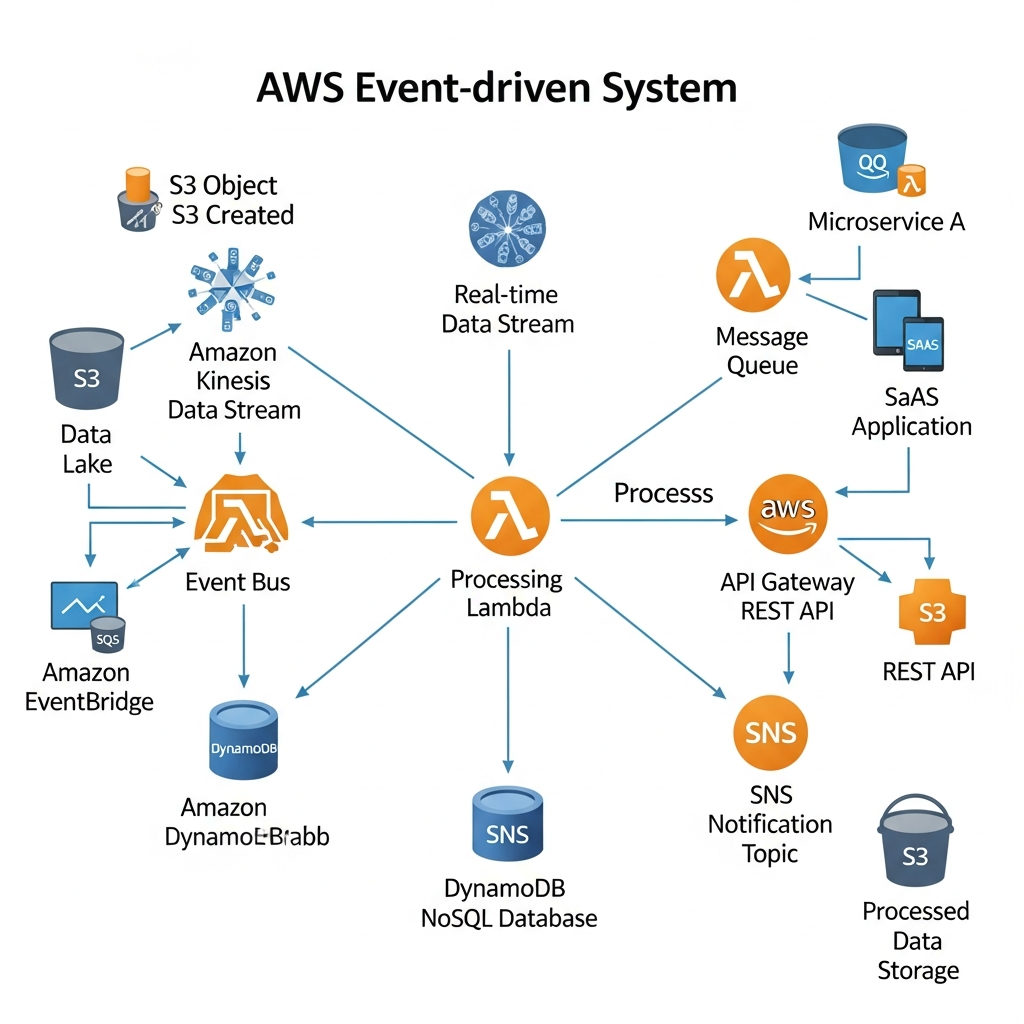
Lambda excels in event-driven architectures where code executes in response to triggers such as HTTP requests via API Gateway, file uploads to S3, database changes in DynamoDB, or scheduled CloudWatch events. This makes it ideal for microservices, data processing pipelines, and automation tasks and thus optimizing cloud infrastructure through best cloud migration services.
Key Benefits of AWS Lambda
- Zero server management: No infrastructure to provision, patch, or maintain
- Automatic scaling: Seamlessly handles concurrent executions without configuration
- Pay-per-use pricing: Only charged for actual compute time, measured in milliseconds
- Built-in fault tolerance: Automatic high availability across multiple availability zones
Understanding EC2: Traditional Virtual Machines
Amazon EC2 provides resizable virtual servers in the cloud, offering complete control over your computing environment. With EC2, you select the instance type, operating system, and configuration that best matches your needs. This flexibility makes EC2 the go-to choice for applications requiring consistent computing power, custom runtime environments, or long-running processes. For comprehensive guidance on AWS services, check AWS cloud computing services guide.
EC2 instances run continuously (or on a schedule you define) and provide full access to the underlying operating system. This makes them ideal for monolithic applications, databases, legacy systems, and workloads that require specialized hardware or software configurations not supported by Lambda.
Key Benefits of Amazon EC2
- Complete control: Full access to operating system and runtime environment
- No execution time limits: Run long-running processes without timeout constraints
- Consistent performance: Predictable compute resources for steady-state workloads
- Wide instance variety: Choose from hundreds of instance types optimized for different use cases
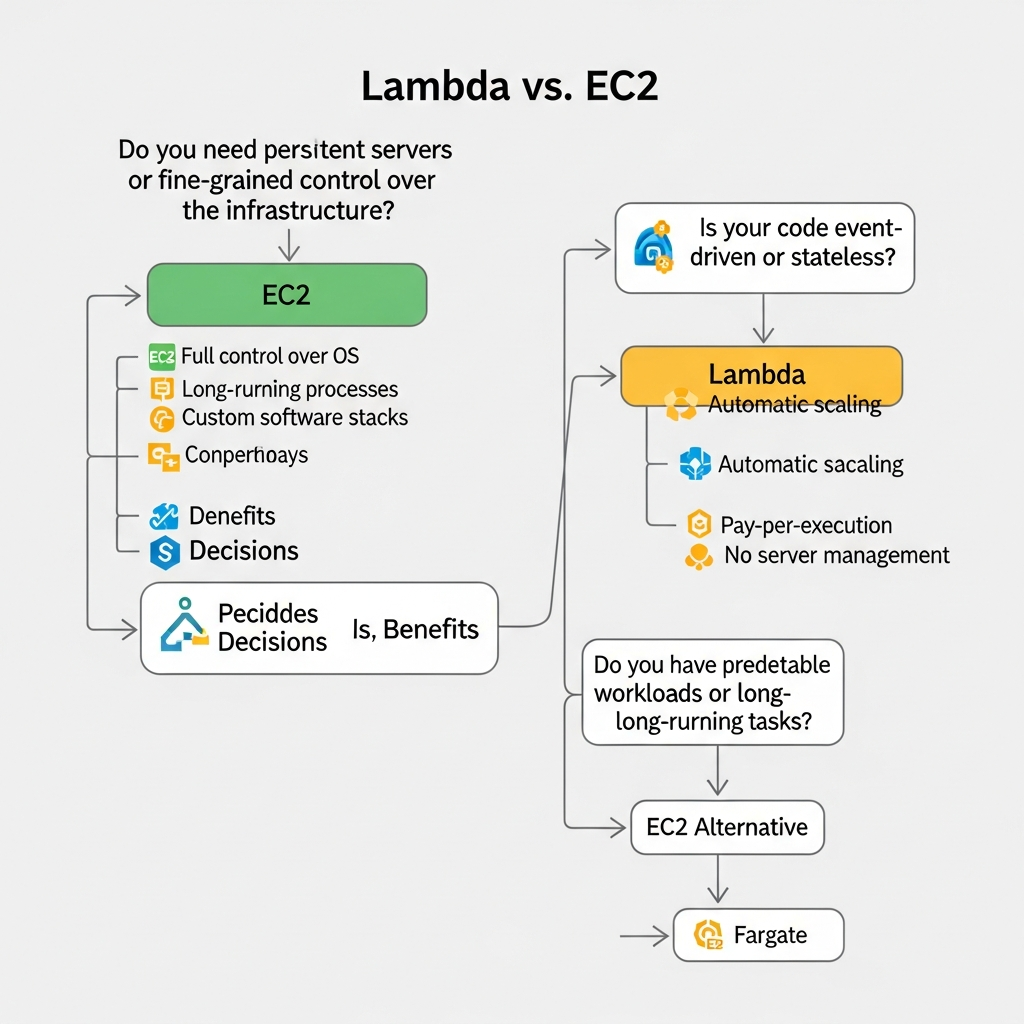
When to Choose Lambda vs. EC2: A Decision Framework
Choose AWS Lambda When:
- Your workload is event-driven and sporadic with unpredictable traffic patterns
- Execution time is under 15 minutes (Lambda’s maximum timeout)
- You want to minimize operational overhead and focus on code, not infrastructure
- The application can tolerate cold starts (typically 100-500ms)
- You’re building microservices, APIs, or data processing pipelines
Choose EC2 When:
- Your application requires long-running processes or continuous execution
- You need full control over the operating system and runtime environment
- The workload has consistent, predictable traffic that runs 24/7
- You’re running legacy applications or using specialized software
- Your application requires more than 10GB of memory or specific GPU configurations
Cost Considerations
For sporadic workloads with low utilization rates, Lambda often provides dramatic cost savings since you only pay for actual execution time. However, for consistently high-traffic applications running continuously, EC2 instances (especially with Reserved Instance pricing) can be more economical. Understanding your workload patterns is crucial for cost optimization.
The break-even point typically occurs when your application runs continuously at moderate to high utilization. Below approximately 30% utilization, Lambda generally offers better economics, while sustained workloads above this threshold may benefit from EC2’s predictable pricing.
The Hybrid Approach: Best of Both Worlds
Modern cloud architectures often leverage both services simultaneously. You might use EC2 for your core application servers and databases while employing Lambda for background processing, API endpoints, and event-driven workflows. This hybrid approach, supported by hybrid and multi-cloud consulting services, optimizes both cost and performance by matching each workload to its ideal compute service.
For example, an e-commerce platform might run its main web application on EC2 for consistent performance, use Lambda functions to process order confirmations and send email notifications, and leverage Lambda for image resizing when products are uploaded. This approach maximizes efficiency and minimizes costs.
Making the Right Choice for Your Business
The decision between Lambda and EC2 isn’t always binary. Consider your specific requirements, including execution duration, memory needs, traffic patterns, and budget constraints. Start by analyzing your workload characteristics and use the decision framework above as a guide. Cloud security solutions ensure both Lambda and EC2 deployments remain secure.
Both AWS Lambda and EC2 have their place in modern cloud architecture. Lambda offers unmatched simplicity and cost-efficiency for event-driven workloads, while EC2 provides the control and flexibility needed for complex, long-running applications. By understanding the strengths and limitations of each service, you can build a cloud infrastructure that delivers optimal performance, scalability, and cost-effectiveness for your business needs.
Need help deciding which AWS service is right for your project? Contact Informatics360 for expert cloud consulting and implementation services.