
+12012030360

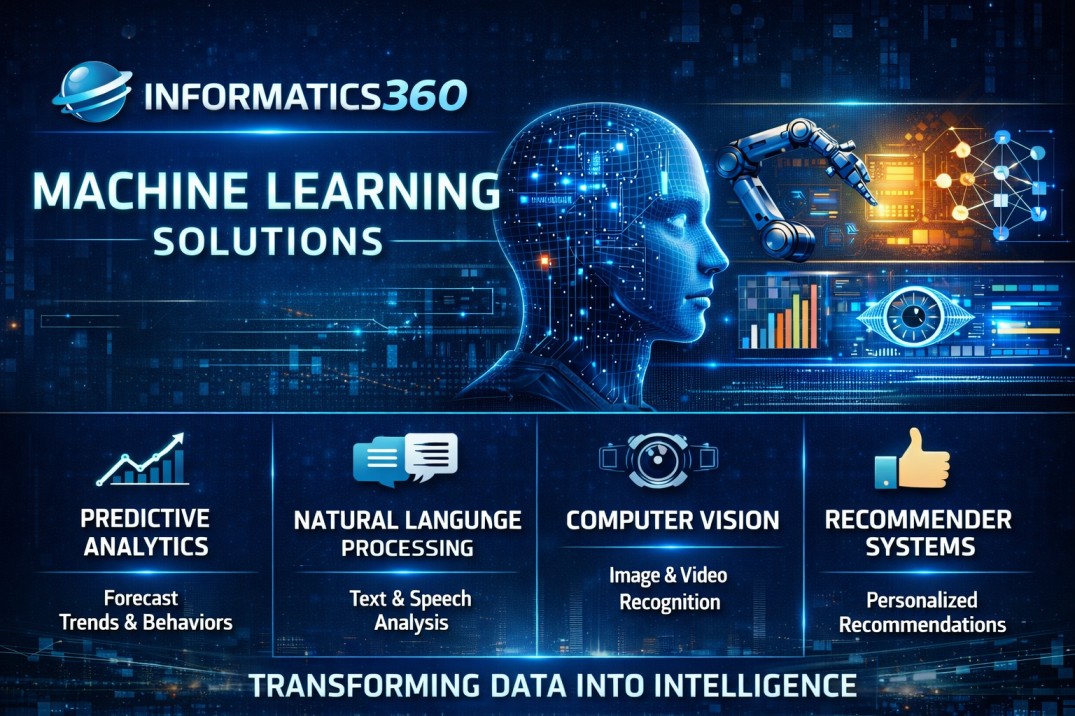
Your Business Is Sitting on a Gold Mine — and Most of It Is Still Untouched
Every business today generates data. Customer transactions, website behaviour, production logs, sensor readings, support tickets, market signals — it accumulates constantly, in volumes that no team of humans could ever meaningfully analyse.
For most businesses, this data sits largely unused. It’s stored, sometimes backed up, occasionally glanced at in a monthly report — but never truly interrogated. The patterns inside it, the early warning signs, the hidden opportunities, the customer behaviour that predicts a purchase or a churn, go unseen.
Machine learning services exist to change that. They turn raw data into genuine intelligence: systems that predict what will happen before it does, automate decisions that used to require expert human judgment, and find patterns too complex and too subtle for any human analyst to detect manually.
In 2026, machine learning will no longer be a technology only available to tech giants. It’s being applied profitably by businesses across financial services, healthcare, retail, logistics, manufacturing, and professional services, at every scale from growing SMEs to global enterprises.
This guide explains clearly what machine learning services actually are, what they can realistically do for your business, what the different types of ML services cover, how businesses across different industries are using them right now, and how to think about readiness and ROI before you start.
What Machine Learning Services Actually Are
Before we get into applications and benefits, let’s make sure we’re working from the same understanding.
What is Machine Learning?
Machine learning is a branch of artificial intelligence in which systems learn from data rather than being explicitly programmed with rules. Instead of a developer writing “if X, then Y,” a machine learning model analyses thousands or millions of historical examples, identifies the patterns in that data, and uses those patterns to make predictions or decisions on new data.
The more data the model is trained on, and the better that data is, the more accurate the model becomes. And unlike a rules-based system that stays static unless a developer updates it, a well-built machine learning model can continue improving as more data flows through it over time.
A simple example: a traditional spam filter might be programmed with rules like “block emails containing the words ‘click here’ or ‘win a prize.'” Clever spammers quickly learn to work around those rules. A machine learning spam filter doesn’t use fixed rules — it learns from millions of examples of spam and non-spam emails, identifies complex patterns across hundreds of signals simultaneously, and keeps adapting as spam tactics evolve. It gets better automatically.
That self-improving, adaptive quality is what makes machine learning genuinely different from traditional software.
What “Machine Learning Services” Means for a Business
When a business engages a machine learning services provider, they’re engaging a team of data scientists, ML engineers, and MLOps specialists to build, train, validate, deploy, and maintain custom ML systems designed for specific business problems.
This isn’t buying software off a shelf. A custom ML solution is built for your specific data, your specific business context, and your specific outcome requirements. The model that works well for predicting equipment failure at one factory is not the same model that should be used to predict customer churn at an e-commerce business. Every meaningful ML engagement starts with understanding the problem, then building the right solution for it.
At Informatics360, we build production-grade machine learning solutions that are explainable, auditable, and designed to keep improving, not just models that perform well in a test environment and fail in the real world.
What are the Main Types of Machine Learning Services
Machine learning isn’t a single thing, it’s a family of techniques applied to different types of problems. Here’s a clear breakdown of the main categories and what each one does in practice.
Predictive Analytics and Demand Forecasting
This is one of the most widely adopted applications of machine learning in business, and one of the highest-ROI use cases when it’s done well.
Predictive analytics uses historical data to build models that forecast future outcomes. How much of a product will sell next month? Which customers are most likely to churn in the next 90 days? What is the probability that a piece of equipment will fail in the next two weeks? How will demand change if we adjust pricing by 10%?
These aren’t guesses, they’re statistically grounded predictions built on patterns extracted from your actual data. A well-trained demand forecasting model routinely outperforms even experienced human forecasters, especially for complex products with many influencing variables.
The applications span almost every sector. Retailers use demand forecasting to optimise inventory and reduce waste. Logistics companies use it to allocate fleet capacity. Healthcare providers use it to manage staffing and resource planning. Financial services firms use it to model risk and exposure.
Machine Learning Solutions should include custom predictive models built to your specific data environment and business requirements, with average model accuracy of 85%+ across production deployments.
Classification and Anomaly Detection
Classification models learn to categorise incoming data into predefined groups. Is this transaction fraudulent or legitimate? Is this image a defect or a pass? Is this loan application high-risk or low-risk? Is this patient record consistent with a particular diagnosis?
These models are trained on labelled historical data, thousands or millions of examples where the correct category is already known, and then applied to new, unlabelled data to make real-time decisions at scale.
Anomaly detection is a related but distinct technique: rather than categorising into predefined classes, it learns what “normal” looks like and flags anything that deviates significantly. This is the basis of most AI fraud detection systems, cybersecurity threat detection, and quality control systems in manufacturing.
The business case is often very direct. A fraud detection model that catches 80% of fraudulent transactions with a low false-positive rate saves significant money and protects customer relationships simultaneously. A manufacturing quality control system that flags defects before they reach customers reduces warranty claims, returns, and reputational damage.
Computer Vision and Deep Learning
Computer vision is a branch of machine learning in which models are trained to interpret and act on visual data, images and video. It relies on deep learning, which uses neural networks with many layers to process complex, high-dimensional data like images.
In practical business terms, computer vision enables a range of applications that were previously impossible to automate:
Visual quality inspection, cameras on a production line feed images to a model that identifies defects, dimensional errors, or foreign objects at speeds and consistency levels no human inspector could match.
Document processing and data extraction, models that read and extract structured data from invoices, contracts, identity documents, or medical records, removing manual data entry and its associated errors and costs.
Object detection and tracking, used in logistics for tracking packages, in retail for foot traffic analysis, in security for perimeter monitoring, and in agriculture for crop analysis.
Medical imaging analysis, models trained on thousands of labelled scans that assist clinicians in identifying anomalies, tumours, or disease markers in X-rays, MRIs, and CT scans.
Deep learning is computationally intensive and requires well-curated training data, but the results in the right application are transformative. These are capabilities that simply didn’t exist at commercially viable scale a decade ago. Next-Gen AI Software Development practices will cover deep learning deployments at enterprise scale.
Recommendation Engines and Personalisation
If you’ve ever noticed that Netflix’s suggestions feel scarily accurate, or that an e-commerce site seems to show you exactly the right products, you’ve experienced a recommendation engine built on machine learning.
These systems learn continuously from user behaviour, what people click on, buy, watch, skip, return, rate — and use that learning to surface the most relevant content, products, or actions for each individual user in real time.
For businesses, the commercial impact is measurable and often significant. A well-tuned recommendation engine on an e-commerce platform typically increases average order value, improves conversion rates, and drives repeat purchases, because customers are seeing things they actually want rather than generic promotions.
Beyond retail, recommendation engines are used in media and publishing (content personalisation), financial services (product recommendations based on financial behaviour), healthcare (personalised treatment pathway suggestions), and B2B SaaS (in-app feature guidance based on usage patterns).
The common thread is personalisation at scale, delivering relevance to thousands or millions of individuals simultaneously, which no human team could do manually.
Natural Language Processing (NLP) and Text Analysis
Natural language processing is the branch of machine learning that deals with human language, written text and spoken words. NLP models can understand, classify, summarise, translate, and generate human language, enabling a range of practical applications.
Sentiment analysis, automatically classifying customer feedback, reviews, or social media mentions as positive, negative, or neutral. Used for real-time brand monitoring, customer satisfaction tracking, and product improvement.
Text classification, automatically routing incoming customer emails, support tickets, or documents to the right team or category. Eliminates manual triage and speeds up response times significantly.
Information extraction, pulling structured data out of unstructured text. Useful for processing contracts, research papers, regulatory filings, and customer communications.
Chatbots and conversational AI, understanding customer questions expressed in natural language and responding accurately. More sophisticated than simple rule-based chatbots because they understand intent and context, not just keywords.
Natural Language Processing (NLP) Solutions are built for businesses that need to process, understand, and act on text data at scale.
How a Machine Learning Project Actually Works? Step by Step Guide
Many businesses approach machine learning with some anxiety, often because the process feels opaque. What actually happens? How long does it take? What do we need to provide?
Here’s a clear, honest walkthrough of how a well-run machine learning engagement is structured.
Step 1: Discovery and Problem Definition (Weeks 1–2)
Everything starts with the business problem, not the data, and not the model. The most important question in any machine learning project is: what specific decision or outcome are we trying to improve, and by how much?
This sounds obvious, but it’s where many projects go wrong. “We want to use machine learning for forecasting” is not a problem definition. “We want to reduce inventory overstock by 20% by improving the accuracy of 90-day demand forecasts for our top 500 SKUs” is a problem definition. The specificity determines whether the project is buildable, testable, and ultimately successful.
During discovery, the ML team also assesses your data, what you have, what quality it is, whether it’s sufficient for the problem you’re trying to solve, and what data engineering work is needed before modelling can begin. Good data is the foundation of any effective ML system. Insufficient or poor-quality data is the most common reason ML projects underperform or fail.
Step 2: Data Engineering and Preparation (Weeks 2–6)
Raw business data is rarely ready for machine learning. It needs to be cleaned (inconsistencies, errors, duplicates removed), structured (into the right format for modelling), enriched (sometimes with external data sources), and split into training, validation, and test sets.
This phase is less glamorous than building models but arguably more important. The phrase “garbage in, garbage out” was coined for a reason. Models trained on poor data produce poor predictions regardless of their algorithmic sophistication.
Our team includes dedicated data engineers who work alongside ML scientists to make sure the data pipeline is robust, not just for the initial training run, but for continuous retraining as new data arrives over time.
Step 3: Model Development and Training (Weeks 4–10)
This is where data science happens. The ML team experiments with multiple modelling approaches, trying different algorithms, different feature sets, different architectures, and evaluates each against your defined success metrics on the validation data.
For a predictive forecasting problem, they might evaluate linear regression, gradient boosting, and LSTM neural networks, comparing them on accuracy, speed, and interpretability. For a classification problem, they might test logistic regression, random forests, and gradient boosted trees. For a computer vision problem, they’re likely working with convolutional neural networks and transfer learning from pre-trained models.
The goal isn’t to find the most sophisticated model, it’s to find the model that best solves your specific problem given your data. Sometimes a simpler model outperforms a complex one. Explainability and production performance matter more than academic elegance.
Every model Informatics360 delivers is explainable, meaning we can tell you not just what the model predicts but why, which features drove the prediction, and how confident it is. In regulated industries especially, this isn’t optional.
Step 4: Validation, Testing, and Business Sign-Off (Weeks 8–12)
Before any model goes near a production environment, it’s rigorously tested, not just on historical holdout data, but against real business scenarios. Does it perform well on edge cases? Does it hold up when data quality drops slightly? Does it produce sensible outputs for unusual inputs?
Crucially, the outputs are reviewed with domain experts, the people who actually know the business. A demand forecasting model that achieves good accuracy metrics but produces commercially nonsensical predictions for specific product categories has a problem that data scientists alone might not catch.
This phase is also where the business case is confirmed. What’s the model’s predicted improvement versus the current approach? What does that translate to in financial terms — cost savings, revenue uplift, risk reduction?
Step 5: MLOps Deployment and Production Infrastructure (Weeks 10–14)
Getting a model to perform well on historical data is only half the challenge. Deploying it reliably into a production business environment — at scale, in real time, integrated with your existing systems and data pipelines, is where genuine engineering expertise is required.
MLOps (Machine Learning Operations) is the engineering discipline that bridges this gap. It covers model versioning and registry, automated retraining pipelines, real-time performance monitoring, data drift detection (alerting when the live data starts to look different from the training data), A/B testing frameworks, and rollback capability when something goes wrong.
A machine learning model without MLOps infrastructure is like a car without maintenance. It might work fine initially. But it will degrade over time, quietly, often invisibly, and at some point it will fail in ways that are hard to diagnose.
Every model Informatics360 deploys into production includes full MLOps infrastructure: monitoring dashboards, automated alerts, scheduled retraining cycles, and regular model health reviews. This is what makes the difference between an ML project that delivers long-term value and one that becomes a liability.
Step 6: Knowledge Transfer and Ongoing Optimisation
A well-run machine learning engagement doesn’t create dependency, it builds capability. At the end of every project, your team understands what was built, why specific decisions were made, how to interpret the model’s outputs, and how to flag concerns if performance changes.
We provide full documentation, training for your team, and a structured handover process. And because ML models need ongoing monitoring and periodic retraining, we offer managed ML services that provide continuous oversight, so your models keep improving as your data grows.
Machine Learning in Action — Real Industry Applications
The most useful way to understand what machine learning services can do is through specific industry applications. Here are the use cases that are delivering the highest commercial value right now.
Financial Services and Banking
The financial sector is one of the most advanced adopters of machine learning, for good reason: the datasets are large, the decisions are high-stakes, and the ROI of better predictions is enormous.
Fraud detection is the standout application. Traditional rule-based fraud systems generate both false positives (blocking legitimate transactions) and false negatives (missing actual fraud). Machine learning models analyse hundreds of signals simultaneously, transaction amount, location, device, time of day, merchant category, historical behaviour, and make nuanced real-time decisions that catch more fraud with fewer false alarms. For businesses processing significant transaction volumes, the savings are substantial.
Credit scoring and loan underwriting, ML models that assess credit risk using a broader range of signals than traditional credit bureaus, enabling more accurate risk assessment and better lending decisions for both the lender and the borrower.
Algorithmic trading and market prediction, time-series models that identify patterns in market data to support trading strategies. This is a highly specialised application requiring careful regulatory consideration, but it’s well-established in institutional finance.
Anti-money laundering (AML) monitoring, ML models that identify unusual transaction patterns consistent with money laundering, operating at volumes and speeds that human review teams simply cannot match.
For UK financial services firms, compliance with FCA standards and for US firms with SEC/FINRA rules is built into every model design. AI Cybersecurity Solutions must complement financial ML deployments with robust security layers.
Healthcare and Life Sciences
Healthcare generates some of the richest and most valuable data of any sector, and machine learning is increasingly central to how that data is turned into better patient outcomes.
Diagnostic imaging assistance — deep learning models trained on thousands of labelled medical images that assist radiologists and clinicians in identifying anomalies. Models currently in production can detect certain tumours, diabetic retinopathy, and cardiac abnormalities from scans with accuracy comparable to specialist clinicians — and without fatigue.
Predictive patient risk scoring — models that identify patients at elevated risk of specific outcomes (hospital readmission, sepsis, deterioration) before those outcomes occur, enabling earlier intervention. These models have demonstrated significant reductions in preventable hospital admissions at sites where they’ve been deployed.
Drug discovery acceleration — ML models that analyse molecular structures and biological data to identify promising drug candidates and predict likely efficacy and toxicity. What previously took years of laboratory screening can be narrowed significantly by ML-guided candidate selection.
Clinical pathway optimisation — models that analyse patient journey data to identify the care pathways that lead to the best outcomes for specific patient profiles, supporting clinical decision-making and resource allocation.
Data privacy and model explainability are critical requirements in healthcare ML. Every model must be interpretable enough for clinicians to understand and trust its outputs, and all patient data must be handled in compliance with relevant regulations (HIPAA in the US, NHS data governance standards in the UK). Our approach to data security runs through every healthcare ML engagement.
Retail and E-Commerce
Retail is one of the most competitive sectors in the world, and machine learning has become a genuine competitive differentiator for businesses that deploy it well.
Demand forecasting and inventory optimisation — accurate prediction of what will sell, when, and where. This is the difference between having the right stock at the right time and losing sales to out-of-stocks, or tying up capital in excess inventory. For large retailers managing thousands of SKUs across multiple locations, even a modest improvement in forecast accuracy translates into millions in freed-up working capital and margin improvement.
Dynamic pricing — models that adjust pricing in real time based on demand signals, competitor pricing, inventory levels, and customer segmentation. E-commerce businesses using dynamic pricing consistently outperform those on static price structures in both margin and conversion.
Customer lifetime value prediction — ML models that estimate the long-term revenue potential of individual customers, enabling smarter acquisition spending, retention investment, and segmentation for personalised marketing.
Returns prediction and prevention — models that identify orders most likely to be returned before they ship, enabling proactive interventions (better product information, alternative sizing suggestions) that reduce return rates and their associated costs.
Manufacturing and Industrial
Manufacturing has some of the most compelling ML applications in terms of direct, measurable cost impact.
Predictive maintenance — using sensor data from machines and equipment to predict when components are likely to fail, enabling maintenance at the optimal time rather than on a fixed schedule or after a breakdown. The difference in cost between planned maintenance and unplanned downtime is enormous, particularly in continuous-process manufacturing. Companies implementing ML-driven predictive maintenance typically see 20–40% reductions in unplanned downtime.
Quality control and defect detection — computer vision systems on production lines that inspect 100% of output at machine speeds, catching defects that would otherwise reach customers or require expensive rework. More accurate, more consistent, and infinitely scalable compared to manual inspection.
Production optimisation — ML models that analyse process parameters (temperature, pressure, speed, material properties) and identify the optimal settings for maximising yield, quality, and energy efficiency simultaneously.
Supply chain risk prediction — models that monitor signals across the supply chain — supplier performance, geopolitical indicators, logistics data, weather events — and flag emerging risks before they become disruptions.
Logistics and Transportation
Route optimisation — ML models that calculate the most efficient delivery routes dynamically, accounting for real-time traffic, delivery time windows, vehicle capacity, and driver constraints. The savings in fuel, vehicle utilisation, and driver time compound across large fleets.
Delivery time prediction — accurate ETA prediction improves customer experience and reduces inbound enquiries. ML models outperform rule-based ETAs because they learn from historical delivery data and account for contextual factors.
Warehouse automation — ML-driven robotics and picking systems that optimise warehouse operations, from putaway to order fulfilment.
Professional Services and Legal
Even highly human industries are finding genuine value in machine learning applications.
Contract analysis and risk flagging — NLP models that read contracts and identify non-standard clauses, missing provisions, or elevated-risk terms. Tasks that take legal teams hours can be completed in minutes with high accuracy.
Legal outcome prediction — models trained on historical case data that estimate the likely outcome of litigation scenarios, supporting client advice and settlement decisions.
Knowledge management — systems that surface relevant precedents, regulations, or internal expertise in response to queries, reducing the time professionals spend searching for information.
What Makes a Machine Learning Services Partner Worth Choosing
The market for machine learning services has grown rapidly, and so has the variation in quality between providers. Here’s what actually separates firms that consistently deliver from those that look good in a pitch and struggle in delivery.
Production Experience, Not Just Research Capability
There’s a significant gap between building a model that works well in a Jupyter notebook and deploying a model that works reliably in production at scale, 24 hours a day, with real data that’s messier than training data, integrated with your existing systems, and maintained over time as data patterns change.
The firms worth choosing have production track records, not just academic credentials or research publications. Ask specifically about models that are currently running in production, what industries they were deployed in, and how they’re monitored and maintained. Our team has deployed 100+ machine learning models in production across financial services, healthcare, retail, logistics, and manufacturing.
Domain Knowledge Alongside Technical Capability
A team that understands machine learning but doesn’t understand your industry will build technically sound models that miss commercially important nuances. The best ML services firms combine deep technical capability with genuine domain knowledge — either through in-house industry expertise or through a rigorous partnership approach with your domain experts.
At Informatics360, we start every engagement with deep business problem framing — involving your domain experts from day one, not just at the validation stage. This is what ensures our models solve real business problems rather than interesting technical ones.
Explainability and Auditability as Standard
In regulated industries especially, a model that makes accurate predictions but can’t explain why is not deployable. Clinicians won’t trust a diagnostic model they can’t understand. Compliance teams won’t approve a credit scoring model they can’t audit. Risk teams won’t accept a fraud detection system they can’t interrogate.
Every model we build is explainable, we can tell you which features drove a specific prediction, how confident the model is, and where the model’s uncertainty is highest. This isn’t a nice-to-have; in many sectors it’s a regulatory requirement.
Full MLOps Infrastructure
As discussed in Section 4, MLOps is what keeps models performing well after deployment. Ask any prospective ML services partner how they handle model monitoring, data drift detection, retraining schedules, and model versioning in production. If they don’t have clear, detailed answers, they’re not production-ready.
UK and USA Presence — Local Expertise, Global Delivery
If you’re operating in the UK or USA, working with a firm that has local teams matters. Regulatory context, data governance requirements, and industry-specific compliance frameworks differ significantly between markets. Our offices in London and New Jersey mean we bring local knowledge alongside global ML capability.
Is Your Business Ready for Machine Learning? Honest Assessment
Before investing in machine learning services, it’s worth being clear-eyed about what you need to have in place and what realistic expectations look like.
What You Need Before You Start
Data. Machine learning models are trained on historical data. If you don’t have data, or if the data you have is sparse, inconsistent, or poorly labelled, this is the first thing to address. The good news is that most businesses have more useful data than they realise; it often just needs to be consolidated and cleaned. A good ML partner will help you assess this honestly.
A specific business problem. “We want to use machine learning” is not a starting point. “We want to predict which customers will churn within 90 days so we can intervene proactively” is a starting point. The more specific the problem, the more tractable and measurable the ML solution.
Stakeholder buy-in. Machine learning projects that succeed have business sponsors who are genuinely invested in the outcome. Projects that fail often do so because the business stakeholders aren’t engaged, the outputs aren’t trusted, or the model’s predictions aren’t acted on.
A realistic timeline. A production-quality ML solution takes time to build well, typically three to six months from scoping to go-live for a focused engagement. Rushing the process, particularly the data preparation and validation phases, is the most reliable way to end up with a model that doesn’t perform as expected.
What Realistic ROI Looks Like
The ROI from machine learning can be significant, but it’s specific to the use case and the quality of execution.
Well-executed demand forecasting typically delivers 15–30% reductions in inventory holding costs and out-of-stock events. Predictive maintenance typically delivers 20–40% reductions in unplanned downtime. Fraud detection models typically recover multiple times their implementation cost in caught fraud losses within 12 months. Customer churn prediction and prevention campaigns enabled by ML typically improve retention rates by 10–25%.
What machine learning will not do is generate value without investment in data quality, model engineering, and business process change. The model is a tool — its value depends on how well it’s built and how effectively it’s integrated into your business decisions.
Our average results across production deployments: 85%+ model accuracy, 3x improvement in decision-making speed post-implementation, and 40% reduction in operational costs through ML-driven automation.
When to Start Small
If you’re new to machine learning, starting with a focused, well-scoped pilot is almost always the right approach. Choose a problem where you have good quality historical data, a clear success metric, and a measurable business outcome. Use the pilot to build capability, trust, and internal familiarity with ML systems, then scale from there.
The businesses that get the most value from machine learning over time are the ones that build it as an organisational capability, not a one-off project. That starts with a first engagement that’s well-chosen and well-executed.
Why Informatics360 for Machine Learning Services
Informatics360 is a specialist AI and machine learning firm serving businesses across the UK and USA. Here’s what makes our ML practice different.
We build for production, not for demos. Every model we deliver is engineered for real-world performance, with MLOps infrastructure, monitoring, and retraining built in from day one. We don’t build models that look impressive in a presentation and fail quietly in production.
Our data scientists work with your domain experts from day one. We don’t disappear into a technical black box and emerge with a model weeks later. We work in genuine partnership with your people throughout, because models built without business context rarely solve business problems.
We make models explainable. Whether you’re in financial services, healthcare, retail, or any other sector, we build models that can be interrogated and explained, so your teams can trust them and your compliance teams can approve them.
100+ machine learning models successfully deployed in production, across financial services, healthcare, retail, logistics, manufacturing, and technology sectors globally.
Average 85%+ model accuracy across production deployments, not in controlled test environments, but in live production systems with real business data.
We cover the full ML lifecycle — from data engineering and model development through deployment, MLOps, and ongoing managed optimisation. You don’t need to stitch together multiple providers.
Connected to our broader AI practice, our ML team works closely with our Agentic AI and Intelligent Automation, NLP Solutions, Next-Gen AI Software Development, and Data Analytics and Business Intelligence teams, meaning we can build integrated AI capabilities, not isolated ML models.
Cloud-native ML on your preferred platform, whether you run on AWS, Azure, or Google Cloud, we build ML infrastructure that runs natively in your environment. Our hybrid and multi-cloud expertise means your ML systems are always deployed in the right environment for cost, performance, and compliance.
Offices in London and New Jersey, local teams, local regulatory knowledge, global delivery capability.
Frequently Asked Questions About Machine Learning Services
What is the difference between machine learning and artificial intelligence?
Artificial intelligence is the broad field of building systems that perform tasks normally requiring human intelligence. Machine learning is a specific approach within AI systems that learn from data rather than being explicitly programmed with rules. Most modern AI applications are built on machine learning. All machine learning is AI, but not all AI is machine learning (there are rule-based systems, expert systems, and other approaches that don’t use ML).
How much data do I need to build a machine learning model?
It depends on the problem. For some use cases, a few thousand well-labelled examples are sufficient. For deep learning applications like computer vision, you typically need hundreds of thousands or millions of examples. For forecasting problems, you generally need at least two to three years of historical data, ideally more. The first thing any good ML partner should do is assess your data honestly — not promise results before they know what you’re working with.
How long does it take to build a machine learning solution?
A focused, well-scoped ML engagement typically takes three to six months from discovery to go-live. Larger, more complex projects can take six to twelve months. The timeline depends heavily on data readiness — if significant data engineering is needed, this adds time. Rushing through the data preparation and validation phases is the most common cause of underperforming models.
How much does machine learning development cost?
Costs vary significantly based on scope, data complexity, and deployment requirements. A focused ML pilot for a single, well-defined use case is a lower investment. A full production deployment with MLOps infrastructure, monitoring, and ongoing management is a larger engagement. We offer a free initial ML assessment that gives you a clear picture of scope, timeline, and investment before any commitment.
What is MLOps and why does it matter?
MLOps (Machine Learning Operations) is the engineering discipline that keeps ML models performing reliably in production over time. It covers model deployment pipelines, performance monitoring, data drift detection, automated retraining, version control, and rollback capability. Without MLOps infrastructure, models degrade silently as real-world data patterns change — and businesses often don’t notice until performance has deteriorated significantly.
Do I need to change my existing systems to use machine learning?
Not necessarily. Well-engineered ML solutions are designed to integrate with your existing data infrastructure and business systems — pulling data from your current sources and returning predictions through APIs or dashboards that connect to your existing workflows. Significant system overhaul is rarely required for a well-scoped ML engagement.
Can small businesses benefit from machine learning?
Yes. The cost of machine learning services has come down significantly, and many use cases that were previously only viable for large enterprises are now commercially viable for growing businesses. The key is choosing a use case where you have sufficient data and a clear enough business problem that a focused ML solution can deliver measurable ROI. A good ML partner will tell you honestly whether your situation warrants investment.
The Businesses That Get This Right Will Have an Enduring Competitive Advantage
Machine learning is not magic, and it’s not a shortcut. Done well, it’s one of the most powerful ways to systematically improve how your business operates, making better predictions, automating high-quality decisions at scale, and finding patterns in your data that translate directly into commercial value.
Done badly, with insufficient data, unclear problem definition, no MLOps infrastructure, and models that aren’t trusted or acted on, it’s an expensive disappointment.
The difference between those two outcomes comes down almost entirely to how it’s approached and who you work with.
At Informatics360, we’ve built and deployed over 100 machine learning models in production. We’ve learned what works, what fails, and how to build ML systems that deliver sustained, measurable value long after go-live.
If you’re ready to find out what machine learning could do for your business, or if you’re not sure yet and want an honest assessment, we’d love to talk.
Get your free ML assessment today →
Related Reading From Informatics360
- Machine Learning Solutions — Our full ML service offering
- Next-Gen AI Software Development — AI development at enterprise scale
- Natural Language Processing (NLP) Solutions — Understanding and working with text data
- Agentic AI and Intelligent Automation — Autonomous AI systems and workflow automation
- Data Analytics and Business Intelligence — Turning data into decisions
- AI Cybersecurity Solutions — AI-powered security for modern threats
- How AI Is Revolutionising Business Operations in 2026 — The broader AI transformation picture
- Hybrid and Multi-Cloud Consulting Services — Deploying ML in the right cloud environment
- What Is Data Security? Key Strategies to Protect Your Business — Data security for ML environments
- About Informatics360 — Who we are and what we stand for