
+12012030360

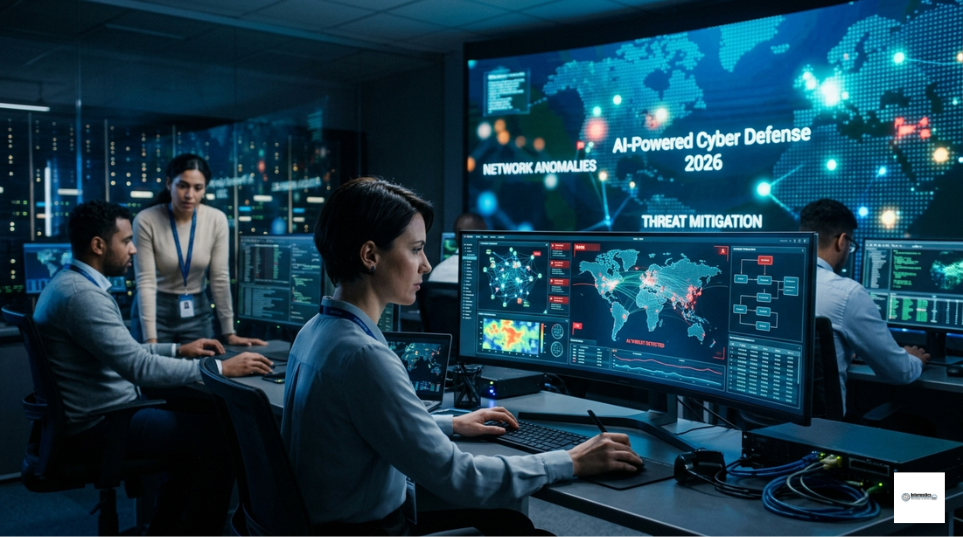
AI for Cybersecurity Solutions Guide How AI Detects, Responds, and Protects Your Business in 2026
Every business connected to the internet is a target. That is not an exaggeration, it is the reality of operating in 2026.
Ransomware attacks rose by over 50% in the past year alone. Phishing campaigns have become so convincing that even experienced security professionals get fooled. Attackers are using artificial intelligence to automate reconnaissance, mutate malware so it evades detection, and launch large-scale credential attacks with minimal human effort.
Meanwhile, the traditional security tools most businesses still rely on , signature-based antivirus, legacy firewalls, rule-based intrusion detection , were built for a threat landscape that no longer exists. They caught yesterday’s attacks. They generate enormous volumes of false-positive alerts that exhaust security teams. And they respond after damage is already being done.
AI for cybersecurity solutions changes this dynamic entirely. Instead of matching threats against a list of known signatures, AI learns what normal looks like in your specific environment , your users, your systems, your network patterns , and detects anything that deviates from that baseline. It does this continuously, across every layer of your infrastructure, at a speed and scale no human team could match.
This guide explains exactly what AI-powered cybersecurity looks like, what the different components do, why traditional approaches are failing, how AI is being applied across different industries, and what businesses should look for in a cybersecurity partner.
Why Traditional Cybersecurity Is No Longer Enough
Before we get into what AI does, it is worth being direct about why the old approach has broken down. Because many businesses still believe that if they have a firewall, an antivirus product, and a basic security policy in place, they are reasonably protected. In 2026, that belief is dangerous.
The Speed Problem
Modern cyberattacks move fast. From initial compromise to full data exfiltration, sophisticated attacks can complete their objective in under four hours. Some ransomware strains encrypt an entire enterprise file system in minutes once they gain a foothold.
Traditional security tools require human analysts to review alerts, investigate anomalies, make decisions, and take action. Even an excellent security operations centre with experienced analysts has a mean time to respond measured in hours or days. That gap , between when an attack begins and when it is detected and contained , is where the damage happens.
AI reduces that gap to minutes or seconds. Automated detection and response systems can isolate a compromised device, revoke a credential, block malicious traffic, and initiate forensic evidence collection within seconds of detecting a threat , before a human analyst has even seen the alert.
The Volume Problem
Large organisations generate millions of security events per day. Log entries, network flows, endpoint telemetry, authentication events, application activity , the sheer volume of data is beyond any human team to meaningfully analyse.
The result is alert fatigue. Security analysts receive hundreds or thousands of alerts per day. The vast majority are false positives generated by rules set too broadly. Analysts become desensitised, start triaging too quickly, and miss genuine threats buried in the noise.
AI solves this by dramatically reducing false positive rates , filtering the noise and surfacing only the alerts that represent genuine risk, with context that helps analysts understand and respond effectively. AI Cybersecurity Solutions achieve a 95% reduction in false positive alert rates, which means security teams spend their time on real threats rather than chasing shadows.
The Novelty Problem
Signature-based detection works by comparing observed behaviour or code against a database of known threats. If the threat is in the database, it is detected. If it is not , if it is a new malware variant, a zero-day exploit, or a novel attack technique , it passes through undetected.
Attackers know this. They routinely modify malware to produce new signatures, use living-off-the-land techniques that abuse legitimate system tools rather than deploying new malicious code, and test their tools against common antivirus products before deployment.
AI-based detection does not depend on known signatures. It detects anomalous behaviour , activity that deviates from what is normal in your specific environment , regardless of whether that behaviour matches any known threat pattern. Zero-day attacks look anomalous. Novel malware behaves anomalously. Even insider threats produce behavioural deviations that AI detects.
The Scale Problem
The modern attack surface is enormous and growing. Cloud infrastructure, remote workers, mobile devices, IoT sensors, third-party integrations, SaaS applications , the number of potential entry points has expanded dramatically over the past five years and continues to grow.
A security team that was sized for a traditional on-premises environment cannot manually monitor this expanded surface. AI provides coverage at scale , continuously monitoring across every environment, every device, every user, without the linear scaling costs of adding human analysts.
What AI for Cybersecurity Solutions Actually Covers
AI cybersecurity is not a single product , it is a set of capabilities applied across multiple security domains. Here is a clear breakdown of what each component does and why it matters.
AI-Driven Threat Detection and Behavioural Analytics
This is the foundation of everything else. AI threat detection models are trained on your environment’s normal patterns , what users typically do, when they log in, what systems they access, what data they move, what network traffic looks like at different times of day.
Once that baseline is established, the system monitors continuously for deviations. A user accessing sensitive files at 2am from an unusual location. A server sending data to an external IP it has never communicated with before. An account logging in from two different countries within the same hour. These are the signals that traditional rule-based systems routinely miss.
User and Entity Behaviour Analytics (UEBA) is a specific application of this , AI models that learn the behaviour patterns of individual users and entities and flag anomalies that suggest compromise, insider threat, or account takeover. The model knows not just that something is unusual in general, but that it is unusual for this specific user , which dramatically reduces false positives while improving detection accuracy.
Network Detection and Response (NDR) applies similar logic to network traffic , learning normal traffic patterns and flagging deviations that suggest lateral movement, data exfiltration, or command-and-control communication.
AI Cybersecurity Solutions achieve an 80% reduction in mean time to detect versus legacy tooling baselines , which directly translates into less damage and lower remediation costs when incidents occur.
Automated Incident Response and SOAR
Detection without response is incomplete. Once a threat is identified, the critical question is how quickly it can be contained. Every second of dwell time , the time between initial compromise and containment , is the time during which an attacker can cause more damage.
Security Orchestration, Automation and Response (SOAR) platforms use AI to automate response actions. When a behavioural anomaly is detected, predefined response playbooks execute automatically: isolating the affected device from the network, revoking the compromised credential, blocking the malicious IP at the firewall, capturing forensic evidence, and creating an incident ticket , all within seconds of initial detection.
This does not eliminate the need for human analysts. It ensures that the immediate containment actions happen at machine speed, giving analysts time to investigate properly and make strategic decisions about remediation , rather than spending that time on manual containment steps that should happen immediately.
Our average automated incident containment time is under 3 minutes from initial threat detection. For context, the industry average for manual incident response is measured in hours.
This connects directly to our broader Agentic AI and Intelligent Automation practice , applying autonomous AI agents to security operations is one of the highest-value applications of agentic AI in enterprise environments.
Zero-Trust Security Architecture with AI
Zero trust is a security philosophy built on a simple principle: never trust anything by default, always verify. No user, no device, no service is trusted simply because it is inside the network perimeter or because it was trusted yesterday.
In practice, zero trust means continuous authentication and authorisation , every access request is evaluated in context before being granted, and that evaluation continues throughout the session. If behaviour changes mid-session in a way that looks suspicious, access is revoked.
AI makes zero trust genuinely practical at scale. Static zero-trust implementations based on manual policy rules are complex to manage and either too permissive (too many exceptions) or too restrictive (too much operational friction). AI-powered zero trust learns normal access patterns, continuously evaluates contextual risk signals , device posture, location, behaviour, time , and makes access decisions dynamically. The result is a zero-trust architecture that is both secure and operationally smooth.
For businesses moving to hybrid and multi-cloud environments, zero-trust architecture is not optional , it is the only security model that makes sense when the perimeter no longer exists. Hybrid and Multi-Cloud Consulting Services always include zero-trust security design as a core component.
Intelligent Vulnerability Management
Most organisations have more vulnerabilities than they can ever remediate. AI Cybersecurity Solutions is a requirement because a large enterprise might identify tens of thousands of vulnerabilities across its estate in a single scan cycle. Trying to patch everything is impossible. Prioritising based on generic CVSS severity scores alone produces a list that does not reflect actual business risk , because a high-severity vulnerability in an isolated test system is far less urgent than a medium-severity vulnerability in an internet-facing system that processes payment data.
AI-powered vulnerability management changes this by incorporating multiple signals into prioritisation: exploitability in the wild right now, the business criticality of the affected system, the exposure context, active threat intelligence, and the organisation’s specific risk profile. The result is a prioritised remediation list that reflects genuine business risk rather than generic severity classifications.
This is directly relevant to businesses operating in regulated industries where vulnerability management is a compliance requirement , whether that is PCI DSS for payment processing, HIPAA for healthcare data, or ISO 27001 for information security management.
AI-Powered Endpoint Detection and Response (EDR)
Endpoints , laptops, desktops, mobile devices, servers , remain one of the most common initial attack vectors. Traditional endpoint antivirus is ineffective against modern threats that use living-off-the-land techniques, fileless malware, or novel exploits.
AI-powered Endpoint Detection and Response (EDR) continuously monitors endpoint activity , process execution, file access, registry changes, network connections, memory activity , and uses machine learning to identify malicious behaviour patterns even when no malicious code signature is present. When suspicious activity is detected, the endpoint can be automatically isolated from the network while investigation proceeds.
For businesses managing large numbers of remote endpoints , particularly those with distributed workforces , AI-powered EDR provides the visibility and response capability that traditional antivirus cannot. This is especially important in the context of Cybersecurity in 2026, where remote work environments represent one of the fastest-growing attack surfaces.
AI-Enhanced SIEM and Threat Intelligence
Security Information and Event Management (SIEM) platforms aggregate log data from across an organisation’s technology estate and provide a centralised view of security events. Traditional SIEMs generate enormous alert volumes and require significant manual tuning to be useful.
AI-enhanced SIEM applies machine learning to log correlation, threat hunting, and alert prioritisation. Instead of surfacing every event that matches a rule, it identifies genuinely suspicious patterns across multiple data sources simultaneously , connecting dots between events that would look innocuous in isolation but are suspicious in combination.
Integrated threat intelligence feeds provide context: this IP address is associated with known ransomware command-and-control infrastructure; this file hash matches a malware family currently active in your sector; this technique matches a campaign attributed to a specific threat actor group. AI correlates this external intelligence with internal telemetry to surface the most relevant, highest-priority threats.
AI for Phishing Detection and Email Security
Email remains the most common initial attack vector for ransomware, business email compromise (BEC), and credential phishing. And phishing attacks have become dramatically more sophisticated , AI-generated phishing emails now routinely pass traditional spam filter tests and fool experienced users.
AI email security goes beyond filtering based on sender reputation and keyword lists. It analyses the full context of each email: the sender’s communication patterns, the content and intent, embedded links and their behaviour, the relationship between sender and recipient, and the timing relative to other activity. It learns what legitimate emails from each sender look like and flags emails that deviate from those established patterns.
For business email compromise specifically , where attackers impersonate executives or suppliers to authorise fraudulent payments , AI that understands normal communication patterns between individuals is far more effective than rules-based filtering. Ransomware Protection guide for a deeper look at defending against email-borne threats.
AI Cybersecurity Across Industries , Where the Stakes Are Highest
AI-powered cybersecurity is valuable across every sector, but the specific threat landscape, compliance requirements, and highest-risk attack surfaces vary significantly by industry. Here is how AI cybersecurity is applied in the sectors most relevant to Informatics360’s clients.
Financial Services
Financial services organisations are among the most heavily targeted by cybercriminals , for obvious reasons. They hold vast quantities of valuable data and process enormous financial flows. They are also among the most heavily regulated when it comes to data security.
Fraud detection in real time is one of the most mature AI security applications in finance. ML models that analyse transaction patterns, device fingerprints, behavioural signals, and network context can identify fraudulent transactions within milliseconds , before they complete. These models go far beyond rules-based fraud detection: they identify complex, multi-step fraud patterns that span days or weeks and involve multiple accounts or instruments simultaneously.
Insider threat detection is equally critical in financial services, where privileged users with access to sensitive systems represent a significant risk. UEBA models that learn individual behaviour patterns can detect when an employee begins accessing systems or data inconsistent with their normal role , potentially indicating compromise, credential theft, or malicious insider activity.
Regulatory compliance monitoring , FCA in the UK, SEC and FINRA in the US , requires financial institutions to monitor communications and transactions for evidence of market abuse, insider trading, and mis-selling. AI that can analyse the full volume of communications and transactions in real time, flagging items for compliance review, provides a level of coverage that manual sampling cannot approach.
Business email compromise is one of the highest-value attack targets in financial services. AI email security that detects CEO fraud, supplier impersonation, and invoice manipulation saves organisations from payment fraud losses that can run into millions.
AI Cybersecurity Solutions are designed with financial services compliance requirements built in , every deployment is aligned with the regulatory frameworks your organisation operates under.
Healthcare
Healthcare organisations are disproportionately targeted by ransomware. Patient data is among the most valuable data type on the criminal marketplace. Clinical systems are operationally critical , a hospital whose patient record system is encrypted cannot safely deliver care. And many NHS trusts and US hospital networks are running ageing infrastructure with significant vulnerability exposure.
Medical record system protection , AI-powered monitoring that detects anomalous access to patient records, identifying both external attackers and insider threats (including curiosity-driven inappropriate access by staff). Essential for HIPAA compliance in the US and NHS data governance standards in the UK.
Ransomware prevention and early detection , behavioural detection models that identify ransomware-consistent behaviour (mass file access, encryption activity, shadow copy deletion) at the earliest possible stage, enabling containment before significant data is encrypted.
Medical device security , connected medical devices (infusion pumps, imaging systems, monitoring equipment) represent a significant and often overlooked attack surface. AI-powered network monitoring that identifies anomalous behaviour from connected devices is essential for modern healthcare security.
Third-party risk management , healthcare organisations work with large numbers of technology suppliers and system integrators. AI that monitors third-party access and detects anomalous supplier behaviour helps manage the supply chain risk that has been behind many of the most significant healthcare breaches.
Data privacy in healthcare AI security engagements is managed with the same rigour as clinical data , our approach to data security covers the full spectrum of requirements relevant to healthcare environments.
Retail and E-Commerce
Retailers hold payment card data, customer personal information, and loyalty programme data , all of which are valuable targets. They also operate complex, distributed technology estates spanning physical stores, e-commerce platforms, logistics systems, and marketing stacks.
Payment fraud prevention , AI models that detect fraudulent payment card transactions in real time, distinguishing genuine customer behaviour from account takeover and card-not-present fraud. Critical for PCI DSS compliance.
E-commerce bot detection , AI-powered bot management that distinguishes legitimate customer traffic from malicious bots conducting credential stuffing, inventory hoarding, web scraping, and price manipulation.
Supply chain and third-party security monitoring , retailers work with enormous ecosystems of suppliers, logistics partners, and technology vendors. AI that monitors for anomalous third-party activity and flags supply chain compromise attempts before they reach customer-facing systems.
Loyalty programme fraud , AI that identifies account takeover and fraudulent point redemption activity in loyalty programmes, protecting both customer accounts and retail margins.
Manufacturing and Critical Infrastructure
Manufacturing and critical infrastructure face an increasingly serious threat landscape as operational technology (OT) systems , previously isolated from IT networks , become connected to enterprise systems and the internet.
IT/OT security convergence , monitoring that covers both traditional IT systems and operational technology environments (SCADA systems, industrial control systems, PLCs) simultaneously, using AI to detect threats that move between IT and OT environments.
Ransomware targeting operational systems , manufacturing is one of the most heavily targeted sectors for ransomware precisely because production downtime is immediately commercially devastating. AI-powered early detection and automated containment that prevents ransomware from reaching production systems.
Insider threat in high-security facilities , AI monitoring of privileged access to critical systems, detecting anomalous behaviour by contractors, maintenance personnel, or employees with access to sensitive operational environments.
Professional Services and Legal
Professional services firms , law firms, consultancies, accountancies , hold client data, intellectual property, and sensitive communications that are highly valuable targets, particularly in the context of commercial litigation, M&A transactions, and regulatory investigations.
Client data protection , AI monitoring that detects unauthorised access to client files, unusual bulk data access, or data exfiltration attempts targeting sensitive client information.
Email compromise targeting M&A , law firms and investment banks involved in sensitive transactions are specifically targeted by attackers seeking advance knowledge of deals. AI email security that detects account compromise and anomalous communication patterns is critical during active transactions.
How an AI Cybersecurity Engagement Works , From Assessment to Active Defence
Understanding what an AI cybersecurity deployment actually involves helps set expectations and plan effectively.
Stage 1: Security Posture Assessment (Weeks 1–2)
Every engagement starts with an honest assessment of where you are. Your current security controls, technology stack, network architecture, identity management, cloud configuration, endpoint coverage, and compliance status are evaluated thoroughly.
This is not a checkbox exercise. The goal is to understand your specific threat landscape , which attack surfaces are most exposed, what your highest-risk assets are, where the gaps between your current controls and your actual risk profile sit, and what an attacker who targeted your organisation specifically would likely exploit.
The assessment produces a clear, prioritised picture of your security risks , the foundation for an intelligent deployment strategy that addresses the highest-priority gaps first. Get a free security assessment from Informatics360.
Stage 2: Architecture Design and Tool Selection (Weeks 2–4)
Based on the assessment, the security architecture is designed. Which detection capabilities are needed and where? What data sources need to feed the AI models? How does automated response integrate with your existing tooling? What zero-trust controls are required and where?
Critically, AI cybersecurity deployments are calibrated to your specific environment. An AI threat detection model trained on generic enterprise data will produce a high false-positive rate in your specific environment because your normal looks different from generic normal. Effective deployment requires tuning to your specific baseline , which is done during this stage.
This architecture design connects directly to your cloud infrastructure. Whether you run on AWS, Azure, or Google Cloud, security controls need to be embedded into your cloud environment natively. Our Hybrid and Multi-Cloud Consulting Services ensure security architecture is always part of cloud design, not bolted on afterwards.
Stage 3: Phased Deployment and Tuning (Weeks 4–12)
AI security capabilities are deployed in controlled phases, starting with detection and monitoring before activating automated response. This phased approach is important , automated response capabilities need to be properly tuned before they are set to act autonomously, to ensure they respond accurately and do not cause operational disruption.
During the tuning phase, detection models are calibrated against your real environment, response playbooks are tested and validated, and false positive rates are driven down to operational levels. This is the phase that separates deployments that work well from deployments that generate more noise than they resolve.
Stage 4: Continuous Monitoring and Threat Intelligence Updates (Ongoing)
AI security is not a deploy-and-forget capability. The threat landscape evolves, your environment changes, and AI models need to be updated and retrained as both evolve. Ongoing managed security services include:
- Continuous monitoring of AI detection model performance
- Regular threat intelligence feed updates
- Model retraining as new attack patterns emerge
- Monthly security posture reports and threat landscape briefings
- Regular red team exercises to validate detection effectiveness
- Compliance reporting for regulated industries
AI Cybersecurity Solutions managed service provides all of these as a continuous, proactive defence capability , not a periodic review exercise.
What to Look for in an AI Cybersecurity Partner
The market for AI cybersecurity services is crowded and the variation in quality is significant. Here is what genuinely matters when evaluating partners.
Real Detection Performance Metrics, Not Marketing Claims
Ask for specific, evidenced performance data: false positive rates in production deployments, mean time to detect, mean time to respond, percentage of incidents caught before damage occurred. Any credible AI cybersecurity firm should be able to provide these for comparable engagements.
Ours: 95% reduction in false positive rates, 80% reduction in mean time to detect, average automated containment in under 3 minutes, 500+ incidents automatically detected and contained across managed environments.
Security Engineering and AI Expertise Combined
AI cybersecurity requires two distinct skill sets working together: deep security operations expertise (understanding of attack techniques, incident response, threat intelligence, compliance frameworks) and machine learning engineering capability (model development, MLOps, data engineering). Firms that are strong in one but weak in the other produce solutions that are either technically sophisticated but operationally impractical, or operationally familiar but technically shallow.
Industry-Specific Knowledge
A cybersecurity partner who understands your regulatory environment, your specific threat landscape, and the compliance frameworks you operate under is significantly more valuable than a generic security provider. Ask specifically about experience in your sector and familiarity with the relevant compliance requirements , FCA, HIPAA, PCI DSS, GDPR, ISO 27001, SOC 2.
End-to-End Capability
Security is not an isolated domain , it intersects with your cloud architecture, your data infrastructure, your application development practices, and your operational technology. A partner with end-to-end capability across these domains provides integrated security that covers the gaps that single-point solutions miss.
AI Cybersecurity Solutions work in close integration with Machine Learning Solutions, NLP Solutions, Cloud Managed Services, and Hybrid and Multi-Cloud Consulting Services , providing security coverage that extends across your entire technology estate.
UK and USA Presence , Local Regulatory Context Built In
Regulatory requirements for cybersecurity differ between the UK and USA. GDPR and FCA in the UK, HIPAA, CMMC, and SEC rules in the US. A partner with physical presence and regulatory expertise in both markets ensures your security deployments are designed for compliance from the outset, not retrofitted.
Why Informatics360 for AI Cybersecurity
At Informatics360, AI-powered cybersecurity is a core practice delivered by dedicated security AI engineers with deep expertise across threat detection, incident response, zero-trust architecture, and compliance. Here is what that looks like in practice.
95% reduction in false positive alert rates , across production AI cybersecurity deployments. Your security team focuses on real threats, not noise.
80% reduction in mean time to detect versus legacy tooling baselines , threats are identified faster, meaning less damage, lower remediation costs, and better outcomes for your business.
Under 3 minutes average automated incident containment , from initial detection to isolation and evidence collection, faster than any human-only response process.
500+ security incidents automatically detected and contained across our managed environments , evidenced production performance at scale.
Full AI cybersecurity lifecycle , threat assessment, architecture design, detection model deployment, zero-trust implementation, automated response configuration, ongoing managed monitoring, and compliance reporting. No fragmented responsibility across multiple vendors.
Regulatory alignment built in , every deployment is designed against the specific compliance requirements of your industry and geography. GDPR, FCA, HIPAA, PCI DSS, ISO 27001, SOC 2 , compliance is a design input, not an afterthought.
Integrated with your cloud and AI infrastructure , security is embedded into your cloud environment from the architecture design stage, not bolted on after the fact. Our close collaboration with our cloud and AI teams means your entire technology estate is secured coherently.
UK and USA offices , local teams, local regulatory expertise, global threat intelligence.
Frequently Asked Questions About AI for Cybersecurity Solutions
What is AI cybersecurity and how is it different from traditional security?
Traditional cybersecurity relies primarily on rules and signatures , matching observed behaviour against lists of known threats. AI cybersecurity uses machine learning to learn what normal looks like in your specific environment and detect deviations from that baseline, regardless of whether those deviations match any known threat pattern. This makes AI effective against zero-day attacks, novel malware, and insider threats that rules-based systems routinely miss. It also enables automated response at machine speed, dramatically reducing the time between detection and containment.
Does AI cybersecurity replace human security analysts?
No , and any vendor who suggests it does should be approached with scepticism. AI handles the volume and speed challenges that exceed human capacity: processing millions of events, detecting anomalies in real time, executing initial containment automatically. Human analysts handle the strategic decisions, the complex investigations, the contextual judgement calls, and the ongoing tuning and governance of AI systems. AI makes human security teams dramatically more effective, not redundant.
How long does it take to deploy AI cybersecurity?
Initial deployment of core detection capabilities typically takes four to eight weeks from assessment to active monitoring. Full deployment including automated response, zero-trust controls, and complete coverage across cloud and on-premises environments is typically eight to fourteen weeks. The phased approach is deliberate , proper calibration of AI models to your specific environment is what makes the difference between a deployment that works well and one that generates noise.
What compliance frameworks does AI cybersecurity support?
AI cybersecurity deployments can be aligned with any major compliance framework , GDPR, ISO 27001, SOC 2, PCI DSS, HIPAA, CMMC, FCA requirements, and others. The specific controls required vary by framework, and a well-designed AI security architecture can satisfy multiple frameworks simultaneously with appropriate documentation and audit trail generation.
Is AI cybersecurity only for large enterprises?
No. The principle that you need a large enterprise budget to access meaningful AI-powered security is no longer true. AI cybersecurity solutions are scalable , the right scope and depth of deployment for a 50-person business is very different from a 10,000-employee enterprise, but the core capabilities are accessible at both scales. A focused deployment addressing your highest-priority risks delivers significant security improvement at a cost that scales appropriately to your size.
How does AI cybersecurity handle cloud environments?
Cloud environments , whether AWS, Azure, Google Cloud, or hybrid , require security controls that are native to those environments, not adapted from on-premises approaches. AI-powered cloud security monitors cloud configuration, workload behaviour, identity and access management, and network traffic within and between cloud environments. It integrates with cloud-native security services and extends them with ML-powered detection capabilities that cloud providers’ built-in tools do not offer. Cloud Managed Services include security as a core component of every engagement.
What does a free security assessment from Informatics360 include?
Our free security assessment covers your current security posture against your specific threat landscape , attack surface mapping, current control effectiveness, highest-priority gaps, and compliance status. You receive a clear, prioritised picture of your security risks and practical recommendations for improvement. No commitment required.
Conclusion: The Attackers Are Using AI. Your Defences Should Too.
The threat landscape has changed fundamentally. Attackers are using AI to automate reconnaissance, craft convincing phishing campaigns, mutate malware to evade detection, and launch high-volume credential attacks with minimal human effort. The speed and sophistication of modern attacks has outpaced what traditional security tools and human-only response processes can handle.
Businesses that continue to rely on legacy security approaches , signature-based detection, rule-based monitoring, manual incident response , are operating with defences that were designed for a threat environment that no longer exists. The question is not whether they will experience a significant security incident, but when.
AI for cybersecurity solutions is not a future technology. It is the present reality for the businesses that are successfully defending themselves against modern threats. It detects faster, responds faster, and covers the attack surface at a scale that human-only security cannot.
At Informatics360, our AI cybersecurity practice has detected and contained over 500 incidents across managed environments, achieved 95% reductions in false positive rates, and reduced mean time to detect by 80% versus legacy tooling. These are production results , not controlled environment benchmarks.
If you want to understand exactly where your security posture stands today and what AI-powered security would change for your business, we offer a free, no-commitment security assessment.
Get your free security assessment today →
Related Reading From Informatics360
- AI Cybersecurity Solutions , Our full AI security service offering
- Cybersecurity in 2026: Protect Data Across Cloud, AI and Remote Work , The 2026 threat landscape overview
- Ransomware Protection: A Complete Guide for USA Businesses , Deep dive on ransomware defence
- What Is Data Security? Key Strategies to Protect Your Business , Foundational data security guide
- Cyber Security Services UK , UK-specific cybersecurity services
- Cybersecurity Services: Business Protection , Business protection overview
- Machine Learning Solutions , The ML models powering AI security
- Agentic AI and Intelligent Automation , Autonomous AI agents in security operations
- Hybrid and Multi-Cloud Consulting Services , Cloud security architecture
- Cloud Managed Services , Ongoing cloud security management
- NLP Solutions , NLP for threat communications and phishing analysis
- About Informatics360 , Who we are