
+12012030360

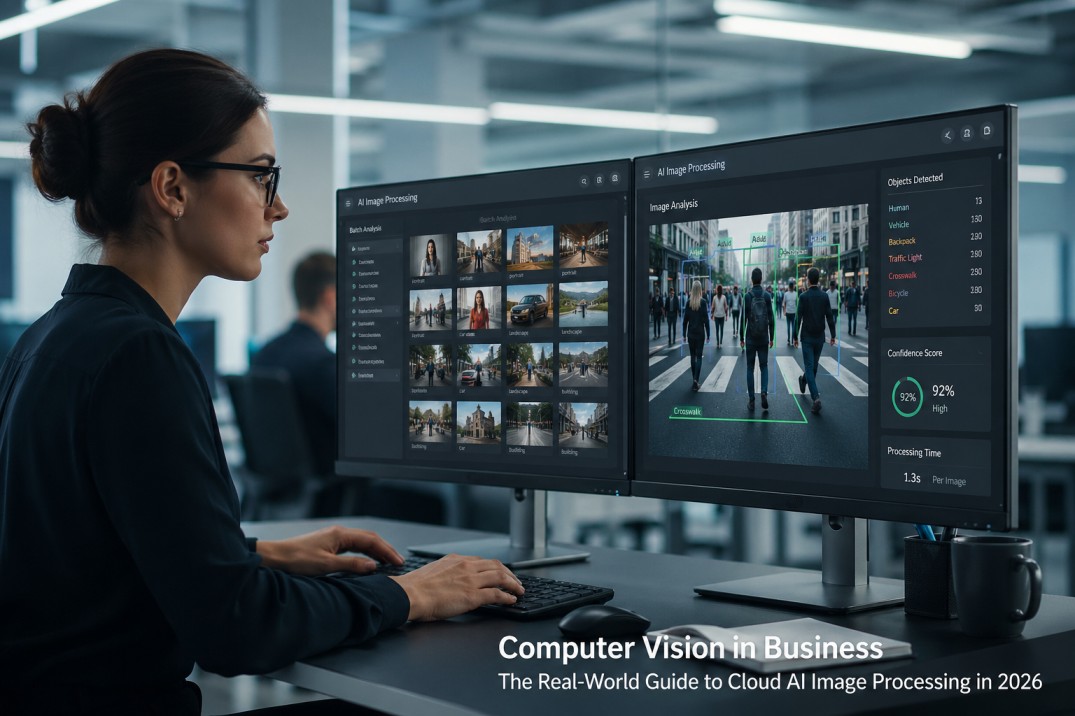
Your Business Sees a Lot. But Does It Understand What It’s Looking At?
Think about how much visual information passes through your business every single day.
Cameras on a factory floor capturing thousands of units per hour. Invoices and contracts arriving in their hundreds. Product photos being uploaded to your catalogue. Identity documents submitted by new customers. Security feeds running around the clock. Medical scans queued up for review. Warehouse footage showing exactly where every pallet went.
All of that is data. Rich, detailed, genuinely useful data. The trouble is, most of it just sits there. It gets stored, occasionally glanced at, sometimes reviewed by a human if something goes wrong, but never truly put to work.
That is the problem computer vision solves.
Computer vision is the branch of artificial intelligence that teaches machines to see, understand, and act on images and video, automatically, accurately, and at a speed no human team could match. And in 2026, thanks to cloud platforms that have made these capabilities widely accessible, it is no longer something only the world’s largest technology companies can afford to use. Businesses of all sizes, across every industry, are deploying computer vision right now and seeing real, measurable returns from it.
What Is Computer Vision?
Computer vision is exactly what it sounds like, it gives computers the ability to see.
More precisely, it is a field of artificial intelligence in which systems are trained to look at an image or video, identify what is in it, and do something useful with that information. That might mean reading the text on a document. It might mean detecting a defect on a product. It might mean recognising a person’s face. It might mean flagging an anomaly in a medical scan.
Traditional software cannot do any of this. A conventional program needs explicit rules to follow, if this, then that. It cannot look at a photo of a cracked component and know it is damaged unless a developer has written precise code describing every possible type of crack. That is slow, fragile, and ultimately impossible to scale.
Computer vision works differently. Instead of following fixed rules, a computer vision model learns from thousands or millions of labelled examples. Show it a million images of defective products and a million images of good ones, and it learns to tell them apart, on its own, from patterns it has discovered in the data. Show it enough scanned invoices, and it learns to read and extract the relevant fields automatically.
The more data it sees, the better it gets. And once it is trained, it can analyse new images at a speed, scale, and consistency that no human process can match.
This is why the global computer vision market is expected to reach over $80 billion by 2026, because businesses that understand what it can do are investing seriously, and the results are justifying that investment.
Why Cloud AI Changed Everything for Computer Vision
For a long time, computer vision was only accessible to large organisations with dedicated AI research teams, expensive on-premises hardware, and the budget to spend months building and training custom models from scratch.
Cloud platforms changed that completely.
Amazon Web Services, Microsoft Azure, and Google Cloud Platform have each invested billions in building pre-trained computer vision AI services, models already trained on enormous datasets, exposed through clean APIs, running on scalable cloud infrastructure. A business can now integrate powerful image recognition, document reading, face analysis, or video intelligence capabilities into its systems in days rather than months, without needing to hire a team of AI researchers or buy specialist hardware.
This is not just a cost story, although the cost improvement is significant. It is a capability story. These cloud services are continuously updated by teams of world-class AI researchers. They get better over time without any additional investment on your part. They scale automatically to handle any volume of images, processing a million images costs roughly the same per image as processing a thousand.
The practical effect is that even small and mid-sized companies, which previously found computer vision out of reach, can now experiment with these tools at low cost and scale up as needed.
The businesses getting the most from cloud computer vision in 2026 are the ones building these capabilities into thoughtfully designed systems, combining cloud and AI engineering practice with their own data, their own workflows, and the right engineering architecture.
What Computer Vision Can Do for a Business?
Before diving into industry applications, it helps to understand the core capabilities, the building blocks that are combined to solve specific business problems. Through the machine learning solutions is solves many important tasks such as:
- Reading and Extracting Text from Images (OCR)
Optical Character Recognition has been around for decades, but modern AI-powered OCR is a completely different proposition from the rule-based systems of the past. Today’s cloud OCR models can read handwritten text, understand the layout and structure of documents, extract specific fields without being told exactly where to look, and handle poor image quality or unusual fonts with high accuracy.
For businesses, this translates directly into automated document processing, invoices, contracts, forms, identity documents, medical records, processed automatically, accurately, and at scale, without anyone manually typing out the information.
- Detecting and Classifying Objects
Object detection models can identify what objects are present in an image, where they are, and what category they belong to, simultaneously, across thousands of images. A retail system uses this to identify products on a shelf. A manufacturing line uses it to spot foreign objects in production. A logistics operation uses it to identify packages and track their movement through a facility.
- Finding Defects and Anomalies
Visual inspection models learn what “normal” looks like and flag anything that deviates, surface defects, dimensional errors, incorrect assembly, unusual patterns. This is how AI quality control works in manufacturing, and it operates with a consistency and speed that human inspection simply cannot match.
- Recognising Faces and Verifying Identities
Facial recognition and biometric verification models compare a live face against a reference image or a database with high accuracy. Used for customer onboarding, access control, fraud prevention, and security monitoring.
- Understanding Video in Real Time
Video intelligence models analyse live or recorded footage frame by frame, tracking movement, identifying behaviour patterns, flagging specific events, and providing real-time alerts when defined conditions are met.
- Labelling and Tagging Images Automatically
Image classification and tagging models can automatically assign accurate labels and metadata to large collections of images, making visual content searchable, organising catalogues, and eliminating manual tagging work entirely.
These capabilities sit at the heart of our practice, and when they are combined intelligently, they can automate workflows that currently cost organisations enormous amounts of time and money.
Real-World Use Cases by Industry
The most useful way to understand computer vision is through what it is actually doing inside real businesses right now. Here is a clear breakdown by industry.
- Manufacturing: Catching Defects Before They Reach Customers
Manufacturing is one of the clearest and highest-ROI applications of computer vision in the world today, because the cost of failures is concrete and the problem is perfectly suited to what AI does well.
Production lines generate images or video of every unit produced. A trained visual inspection model analyses each one in real time, detecting surface defects, cracks, dimensional variations, incorrect labels, missing components, and anything else that deviates from the defined standard. It catches issues that a human inspector might miss, not because human inspectors are careless, but because a camera and a model never get tired, never have an off day, and never lose concentration after hours of watching the same thing go past.
Computer vision systems through engineering-led cloud transformation never blink. They can inspect thousands of components per minute, identifying microscopic cracks or deviations that would be invisible to the human eye.
Beyond defect detection, computer vision is used in manufacturing for tracking component movement through assembly processes, monitoring worker safety and compliance with PPE requirements, and analysing production line throughput to identify bottlenecks.
- Retail and E-Commerce: Making Visual Content Work Harder
In retail, computer vision solves several distinct problems that are expensive to handle manually.
Product image tagging is the most common starting point. A retailer with tens of thousands of SKUs has tens of thousands of product images, each of which needs accurate descriptive metadata, category, colour, material, style, fit, occasion, to be discoverable in search and properly organised in the catalogue. Doing this manually is slow, expensive, and inconsistent. An AI image tagging system processes every image at ingestion and assigns accurate, structured labels automatically, enabling semantic search across the entire catalogue without any human tagging work.
Visual search is the next step, allowing customers to upload a photo of a product they like and find similar items in the catalogue without needing to know the right words to search for. This significantly improves product discovery and conversion rates, particularly on mobile.
Shelf analytics use in-store cameras and computer vision to monitor product placement, track stock levels in real time, and identify when shelves need replenishing, without requiring staff to walk the aisles manually. 44% of retailers are using AI-powered computer vision for better customer experience, and the gap between those retailers and the ones still managing visual data manually is becoming more visible every quarter.
- Healthcare: Where Computer Vision Directly Affects Patient Outcomes
Healthcare is where the human stakes of getting image processing right are highest, and it is one of the areas where cloud AI is making the most significant real-world difference.
Medical imaging, X-rays, CT scans, MRI scans, ultrasounds, is one of the most data-intensive areas of modern healthcare. Radiologists and clinicians who review these images manually are working under significant capacity constraints. Demand for imaging consistently outpaces the supply of specialists qualified to interpret it, which means reports are delayed, diagnosis timelines stretch out, and clinical teams work under pressure.
AI-assisted diagnostic workflows address this at the infrastructure level. Deep learning models trained on large datasets of labelled medical images learn to detect anomalies, tumours, fractures, lesions, signs of disease, and flag them for clinical review. They do not replace the radiologist’s judgment, but they prioritise the most urgent cases automatically and handle the initial screening of routine scans, so clinicians can focus their expertise where it matters most.
The results across deployed systems include faster diagnosis turnaround, reduced radiologist workload on routine cases, and measurably improved accuracy on specific anomaly types where AI models have been validated against clinical benchmarks. Combined with the data analytics and business intelligence capabilities that turn imaging data into population health insights, the full picture of what cloud AI can do for healthcare organisations is genuinely transformative.
Data privacy and compliance are non-negotiable in this context. Every healthcare imaging system needs data security, end-to-end encryption, role-based access controls, and full audit capability, aligned with GDPR requirements in the UK and HIPAA standards in the US.
- Financial Services: Fraud Detection and Document Intelligence
In financial services, computer vision contributes to two of the most commercially valuable use cases: fraud prevention and document processing.
Identity verification at onboarding is the clearest computer vision application in finance. A customer presents an identity document, passport, driving licence, national ID, alongside a live photo. A computer vision model verifies the document’s authenticity, reads the relevant fields, and compares the live photo against the document image in seconds. This replaces a process that previously required human review, reduces fraud at onboarding, and makes the customer experience significantly faster.
Document intelligence applies OCR and document understanding to the enormous volumes of structured and semi-structured documents that financial services organisations process, loan applications, mortgage forms, insurance claims, regulatory filings, compliance documents. Automated extraction, classification, and routing of these documents reduces the manual processing burden, improves accuracy, and accelerates turnaround times at every stage of the workflow.
These capabilities connect directly to agentic AI and intelligent automation work, because the real value is not just in reading a document accurately, but in triggering the right automated workflow based on what it contains.
- Logistics and Warehousing: Visibility at Scale
Logistics is a fundamentally visual domain. Packages, pallets, vehicles, barcodes, labels, loading bays, everything that matters physically needs to be seen, tracked, and accounted for. Computer vision brings automation and intelligence to all of it.
Package recognition and tracking uses cameras at key points in a distribution facility to automatically identify packages, read labels, verify destination routing, and track movement through the facility in real time. Errors in routing, the wrong package going to the wrong place, are caught immediately rather than discovered at delivery.
Visual analytics on warehouse footage provides operational intelligence that did not previously exist, understanding exactly how long packages spend at each processing stage, identifying bottlenecks, tracking asset utilisation, and flagging unusual patterns. This is the kind of real-time operational visibility that turns logistics management from reactive to genuinely proactive.
Vehicle and driver monitoring applies computer vision to fleet operations, detecting driver fatigue or distraction, monitoring loading and unloading processes, verifying cargo security before departure.
Cloud managed services team ensures these systems run reliably at scale, 24 hours a day, with the monitoring and incident response that continuous operations require.
- Security and Identity: Real-Time Protection
Security applications were among the earliest use cases for computer vision, and they remain one of the most mature and widely deployed categories.
Real-time surveillance monitoring uses AI video analysis to watch multiple camera feeds simultaneously and alert security teams when specific events occur, perimeter breaches, abandoned objects, unauthorised access to restricted areas, without requiring a human operator to watch every screen at all times.
Access control systems use facial recognition to verify identity at entry points, replacing physical credentials with biometric authentication that is harder to forge and impossible to share.
Fraud monitoring in physical retail uses computer vision to detect known patterns of shoplifting, identify individuals who have been flagged previously, and alert loss prevention teams in real time.
These applications require careful attention to data privacy regulations and ethical deployment standards. AI cybersecurity solutions practice brings both the technical capability and the compliance framework together, because getting security AI right means getting both the technology and the governance right simultaneously.
What Makes a Computer Vision Project Succeed, or Fail
The honest reality of computer vision deployment in 2026 is that the technology works. The cloud platforms are mature, the models are capable, and the business cases are proven across every major industry. The reason some projects still fail has very little to do with the AI itself.
- Unclear business objectives are the most common cause of failure. A project scoped as “we want to use computer vision” is not a project, it is a wish. A project scoped as “we want to reduce defect escape rate on our assembly line by 30% by automating visual inspection at stations 4 and 7” is a project. The specificity determines whether the system can be properly designed, properly tested, and properly measured.
- Data quality determines model quality. A computer vision model is only as good as the data it was trained on. Insufficient labelled examples, poor image quality, inconsistent lighting conditions, or unrepresentative training data all produce models that underperform in production. The best engineering in the world cannot compensate for weak data. This is why every engagement begins with an honest data assessment before any model work starts.
- Production engineering is different from proof-of-concept engineering. Success comes from pairing the right models with pragmatic engineering: data strategy, edge/cloud tradeoffs, and robust MLOps. A model that performs well in a test environment needs proper deployment infrastructure, continuous performance monitoring, and a retraining process to remain accurate as real-world data patterns evolve. Without MLOps, models degrade quietly, and businesses often do not notice until the problem is significant.
- Security and compliance must be designed in, not added after. Visual data is often sensitive, it includes images of people, documents containing personal information, medical records, and security-relevant footage. Handling it correctly under GDPR, HIPAA, or sector-specific regulations is not optional. These requirements need to be part of the system design from the very first architecture decision.
- Integration with existing systems determines real-world value. A computer vision model that produces accurate outputs but cannot connect to the systems that need to act on those outputs delivers no business value. Every system we build at Informatics360 is API-first, engineered from the outset to integrate with your existing data infrastructure, business applications, and operational workflows.
Cloud vs. Custom: Which Approach Is Right for Your Business?
One of the most important decisions in any computer vision project is whether to use pre-built cloud AI services, build a custom model, or combine both.
Pre-built cloud services, Amazon Rekognition, Azure Computer Vision, Google Cloud Vision AI, are the right starting point for most businesses and most use cases. They are accurate, fast to integrate, continuously improved, and priced on a pay-as-you-go basis that makes them accessible at any scale. For common tasks like OCR, object detection, face verification, and content classification, they perform extremely well without any custom training required.
Custom models become the right choice when your use case has specific requirements that generic models do not meet well, unusual defect types in a specialist manufacturing process, domain-specific document formats, or very high-volume processing scenarios where a custom model is significantly more cost-efficient at scale.
The most successful companies in 2026 are using a hybrid approach, starting with cloud APIs and transitioning to custom solutions when needed. This is exactly the approach we take at Informatics360, using cloud services where they are the best fit, and building custom models where the specific use case demands it. Hybrid and multi-cloud consulting expertise means the infrastructure underneath is always optimised for performance, cost, and compliance regardless of which approach is used.
What to Expect on Cost and Timeline
Being direct about cost and timeline is something many firms in this space avoid. We do not.
A focused integration of a pre-built cloud computer vision service, for example, adding automated OCR document processing to an existing workflow, can typically be scoped, built, and deployed in four to eight weeks. The infrastructure cost runs on a pay-as-you-go basis from the cloud provider, scaled to your actual processing volume.
A custom computer vision model built for a specific industrial or healthcare application, with data collection, annotation, model training, validation, and production deployment, typically takes three to five months from scoping to go-live, with an investment that scales with the complexity of the problem and the volume and quality of training data available.
A full end-to-end intelligent automation pipeline, combining computer vision with downstream workflow automation, analytics integration, and ongoing managed services, is a larger engagement, typically delivered in phases with working functionality at each milestone.
The ROI calculation varies by use case, but it is almost always trackable before you start. Defect escape rate, document processing time, manual review headcount, fraud losses, diagnosis turnaround times, these are all measurable before deployment. Setting clear baselines and targets before development begins is how you ensure the investment delivers what it promised. Cloud migration services team handles the infrastructure side of every deployment, ensuring costs stay predictable and scalable from day one.
Frequently Asked Questions
Do I need a lot of data to get started with computer vision?
It depends on the approach. Pre-built cloud computer vision services require no training data from you at all, they work out of the box. Custom models require labelled training data, and the amount needed varies by use case. Some focused applications work well with a few thousand examples. Others require significantly more. A good starting point is a data assessment with a specialist who can tell you honestly what you have and what you need.
Is computer vision only for large enterprises?
No. Cloud platforms have made the entry cost very accessible. A growing e-commerce business adding AI image tagging, a mid-sized manufacturer adding visual quality inspection, a healthcare technology startup building an AI-assisted screening tool, all of these are viable at a scale and budget that is not enterprise-only. The key is scoping the first use case carefully and building on a foundation that scales.
How do I know if my use case is a good fit for computer vision?
The clearest signal is that your current process involves humans visually reviewing images, documents, or video and making a repeatable decision based on what they see. If that is happening at any meaningful volume, computer vision can almost certainly automate it more accurately and cheaply. The second signal is that you have, or can generate, a reasonable volume of historical examples showing what correct and incorrect outcomes look like.
What about data privacy and GDPR?
Data privacy requirements apply to any system handling images of people or sensitive documents. A properly designed computer vision system addresses this through data minimisation (only storing what is needed), appropriate access controls, encryption in transit and at rest, clear retention policies, and audit logging. These are engineering requirements that need to be in the architecture from the start, not compliance boxes ticked at the end of a project.
What is the difference between computer vision and traditional image processing?
Traditional image processing relies on fixed, manually written rules, pixel thresholds, colour ranges, edge detection algorithms defined by developers. It is brittle: change the lighting conditions or the product slightly, and it breaks. Computer vision uses machine learning models that learn patterns from data. This makes computer vision more adaptable, accurate, and scalable for real-world business environments.
Can computer vision work with video as well as still images?
Yes. Video intelligence is one of the most mature and widely deployed categories of cloud computer vision. Real-time video analysis, event detection, behaviour recognition, and object tracking across video streams are all standard capabilities of leading cloud platforms.
The Businesses That Build This Capability Now Will Be Hardest to Catch Later
Computer vision is not a future technology. It is a present one. The businesses deploying it well right now are already processing visual data faster, catching defects more reliably, onboarding customers more securely, managing inventory more accurately, and diagnosing patients more quickly than their competitors who are still handling these processes manually.
Computer vision is no longer an experimental line item, it is a product capability. The question has shifted from “should we explore this?” to “how quickly can we deploy this in the places where it creates the most value for us?”
The answer to that question depends on having the right partner, one that understands not just the AI, but the engineering, the cloud infrastructure, the data requirements, the compliance considerations, and most importantly, the specific business problem being solved. That combination is what Informatics360 brings to every computer vision engagement.
If you want to understand what computer vision could realistically do for your business, what use cases fit, what your data situation means for feasibility, and what an honest timeline and investment looks like, we are happy to have that conversation with you at Informatics360.