
+12012030360

Every day, organisations generate enormous volumes of visual data. Invoices, product photographs, warehouse feeds, medical scans, identity documents, security footage, and it piles up constantly, across every industry, in every part of the world. The question facing most businesses today is not whether they have enough visual data. They have more than they know what to do with. The real question is how quickly and accurately they can extract value from it.
For most organisations, that question still has an uncomfortable answer. Despite the volume of visual data being created, a large proportion of it is still being handled manually which means classified by hand, tagged by teams of people, processed through disconnected workflows that were built for a different era. The result is slow decision-making, inconsistent quality, high operational costs, and a constant bottleneck that gets worse as data volumes grow.
This is the problem we work on every day at Informatics360. And over many years of working with organisations across retail, healthcare, manufacturing, logistics, and financial services, we have built a clear picture of what it takes to solve it properly. At Informatics360, we help our clients unlock this value by leveraging cloud-native AI services for image processing and intelligent automation, enabling faster decision-making, reduced operational costs, and scalable innovation.
The Real Cost of Handling Visual Data the Old Way
It is easy to underestimate how much manual image and document processing actually costs a business. It is not just the direct cost of the people doing the work, it is the delays it introduces, the errors it creates, and the decisions that could have been made faster if the information had been available sooner.
Many organisations still rely on:
- Manual image classification and tagging
- Time-consuming document processing workflows
- Disconnected systems with limited automation
These approaches are not only inefficient but also prone to human error and scalability limitations.
For example, In healthcare, a radiologist reviewing scans manually can only process a finite number of images per day. When imaging volumes exceed that capacity, reports are delayed, diagnoses take longer, and clinical teams work under unnecessary pressure. In manufacturing, a quality inspector checking products by eye misses defects at a rate that no business wants to admit, and the cost of a defect reaching a customer is many times the cost of catching it in the factory. In retail and media, teams manually tagging thousands of product images or pieces of content are spending hours on work that adds no creative value and could be eliminated entirely.
The problem is the same in every sector, the process was designed for a world where automation was not available. That world has changed.
OurApproach: Cloud-Powered Computer Vision & AI
When we work with a client on image processing and visual automation, we are not starting from scratch.
- Amazon Web Services
- Microsoft Azure
- Google Cloud Platform
These platforms provide pre-trained AI services and scalable infrastructure, allowing businesses to integrate advanced capabilities without building models from scratch.
This matters more than it might seem. Building a computer vision model from scratch requires enormous volumes of labelled training data, months of development time, and ongoing maintenance as the model encounters new inputs. Cloud-native AI services shortcut most of that. They arrive pre-trained on massive datasets, they are updated continuously by teams of researchers at the cloud provider, and they expose clean APIs that integrate into business workflows in days rather than months. Cloud migration and engineering practice makes sure every solution we deploy is built on infrastructure that is properly sized, secured, and cost-optimised from day one.
Key Services We Leverage
- Image & Video Analysis
For Image & Video Analysis:
- Amazon Rekognition
- Azure Computer Vision
- Google Cloud Vision AI
These services enable:
- Object and scene detection
- Facial recognition and verification
- Optical Character Recognition (OCR)
- Content moderation and classification
They are production-grade services used by some of the world’s largest organisations, and we deploy them in architectures designed to meet the specific performance, security, and compliance requirements of each client.
Real-World Use Cases Delivered by Informatics360
1. Automated Document Processing
We implemented OCR-driven pipelines using cloud vision APIs to:
- Extract data from invoices, forms, and contracts
One of the most immediate and measurable applications of cloud computer vision is in document processing. For many organisations, the flow of incoming documents, invoices, contracts, forms, applications, identity documents, represents a persistent operational bottleneck. People spend hours extracting information from these documents, validating it, and entering it into downstream systems. It is repetitive, error-prone, and completely automatable.
- Automatically classify and route documents
The pipelines we build use optical character recognition through cloud vision APIs to read documents accurately, extract the relevant data fields, validate the extracted information against business rules, and automatically classify and route documents to the right workflow or system. An invoice processing pipeline, for example, can read the vendor name, invoice number, line items, and payment terms, match them against purchase orders in the ERP system, flag discrepancies for human review, and pass clean invoices straight through to accounts payable, without any manual touchpoint. The impact we have consistently delivered for clients on these workflows is up to 70% reduction in manual processing time, alongside meaningful improvements in data accuracy and regulatory compliance.
This kind of automation sits at the intersection of computer vision work and broader agentic AI and intelligent automation practice, because the real value is not just in reading the document, but in triggering the right downstream actions automatically based on what the document contains.
2. Intelligent Image Tagging & Search
For Retailers and media businesses clients, visual content is central to the product, but managing it at scale is genuinely difficult. A retailer with tens of thousands of product SKUs has tens of thousands of product images, each of which needs accurate metadata to be discoverable in search, properly organised in the catalogue, and correctly presented to customers on the right pages. Doing this manually is expensive, slow, and inconsistent.
The AI-driven image tagging systems we deploy automatically label images with accurate, structured metadata at the point of ingestion. A product image is tagged with its category, colour, material, style, and other relevant attributes before a human ever touches it. Beyond individual tags, these systems enable semantic search across large visual content libraries, meaning a user searching for “navy blue cotton blazer with silver buttons” finds exactly the right images even if none of those words appear verbatim in the metadata.
For clients who have implemented this, the result is faster content discovery, significantly reduced dependence on manual tagging teams, and a catalogue that is consistently better organised than it was before. It also frees creative and merchandising teams to spend their time on work that actually requires human judgment, not on tasks that a well-configured AI pipeline handles better.
3. Quality Inspection & Visual Analytics
In manufacturing and logistics:
Visual quality control is one of the highest-impact applications of computer vision, because the cost of failures is concrete and measurable. A defective product that reaches a customer generates returns, warranty claims, customer complaints, and potential reputational damage. A defect caught on the production line before it ships costs a fraction of that.
The AI models we deploy for quality inspection work from camera feeds on the production line, analysing every unit as it passes. They detect surface defects, dimensional errors, incorrect assembly, foreign objects, and labelling issues at speeds and consistency levels that no human inspector can match, and they do it without fatigue, shift changes, or the natural drift in attention that affects any repetitive human task over hours.
In logistics, visual analytics extend this capability to movement and pattern tracking across warehouses and distribution centres, monitoring throughput, identifying bottlenecks, tracking asset utilisation, and flagging anomalies in real time. The combination of better quality assurance and more accurate operational data is what machine learning solutions are designed to deliver at scale, embedded in production workflows from day one.
4. Security & Identity Verification
Identity verification and security monitoring are use cases where the speed of AI decision-making matters most. A fraud attempt does not wait for a manual review process. A security incident does not pause while footage is pulled and reviewed. The value of AI in these applications is specifically its ability to operate in real time assessing, flagging, and triggering responses faster than any human-operated system could.
Using AI-powered facial recognition and video analysis, we build real-time identity verification workflows for onboarding, access control, and transaction security. An individual presenting an identity document is verified against a live facial comparison in seconds. A transaction with signals inconsistent with the account holder’s normal behaviour is flagged before it completes. Security footage is monitored continuously for defined anomaly patterns without requiring a human operator watching every feed simultaneously.
The practical business outcomes are enhanced security posture, faster and more reliable customer onboarding, and fraud prevention at a scale that manual review could not achieve. These capabilities are tightly integrated with AI cybersecurity solutions, because identity and security are two sides of the same protection layer.
Transforming Healthcare with AI-Driven Medical Imaging
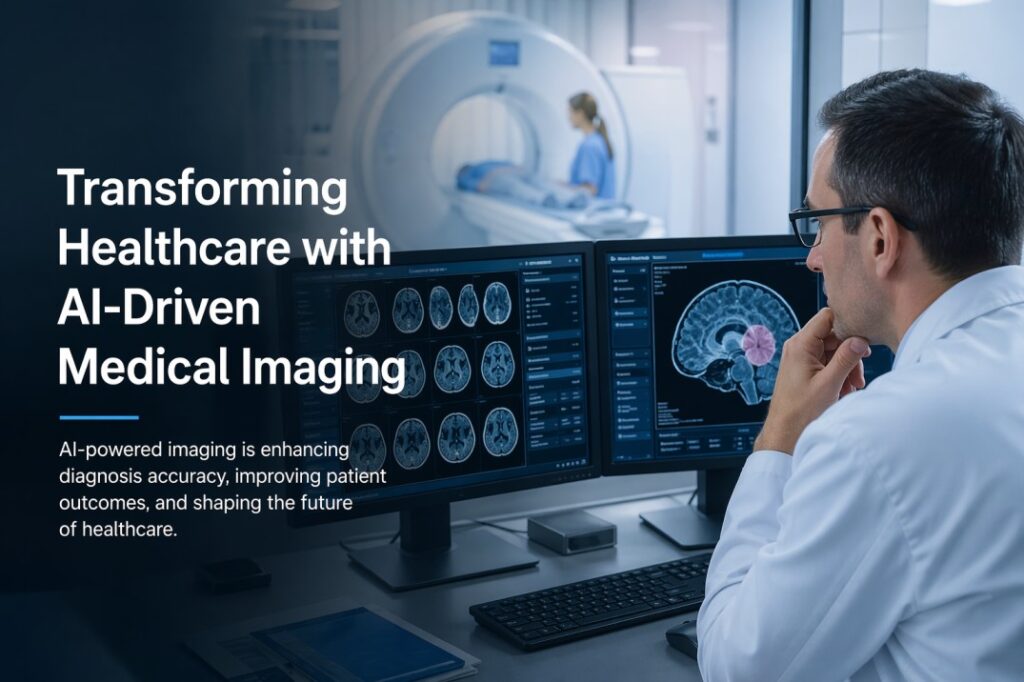
One of the most impactful applications of cloud-based image processing is in the healthcare sector, where speed, accuracy, and scalability are critical. Informatics360 supports healthcare providers and health-tech organisations in modernising how medical images are processed, analysed, and utilised. Every day, healthcare systems generate massive volumes of imaging data in the form of X-rays, CT scans, MRI scans, ultrasounds, and the traditional workflow for processing that data places enormous demands on radiologists and clinicians who are already working at or beyond capacity.
Traditionally, these require manual review by radiologists, leading to:
- Delays in diagnosis
- High workloads for clinicians
- Variability in interpretation
The work we do in healthcare imaging is designed to address this at the infrastructure level, not by replacing clinical judgment, but by removing the bottlenecks and inefficiencies that slow it down.
Our Approach: AI-Assisted Diagnostic Workflows
By leveraging advanced healthcare-focused cloud services, We build on healthcare-focused cloud service such as:
- Amazon HealthImaging
- Azure Health Data Services
- Google Cloud Medical Imaging Suite
These solutions support:
These platforms provide high-performance storage and retrieval of medical images in DICOM format, seamless integration with electronic health record systems, and the infrastructure to run AI models against imaging data at clinical scale. The security and compliance architecture is built to meet GDPR requirements, with end-to-end encryption, role-based access controls, and full auditability across every interaction with patient data. Data security standards run through every healthcare engagement we deliver.
Healthcare Use Cases Delivered
AI-Assisted Radiology
The AI models embedded in these pipelines assist radiologists with anomaly detection, flagging potential tumours, fractures, lesions, and other abnormalities for clinical review. They prioritise the most urgent cases automatically, ensuring that critical findings reach the right clinician without waiting in a general queue. The result across the deployments we have delivered is faster diagnosis turnaround, improved clinical accuracy, and a meaningful reduction in the volume of routine image review that radiologists need to perform manually.
Beyond radiology, automated imaging workflows handle the ingestion and initial analysis of scans as they arrive, generating real-time flags for urgent cases and feeding structured data into analytics pipelines that support population health insights and treatment planning. When imaging data is combined with patient records through integrated data analytics and business intelligence capabilities, the result is a significantly richer clinical picture, one that supports better individual care and better understanding of health patterns across patient populations.
Automated Imaging Workflows
The vision behind everything we build in image processing is not just recognition, it is automation. Reading an image accurately is only useful if it triggers the right action in the right system at the right time. That complete pipeline from data ingestion through AI analysis to downstream action, is what separates a genuinely useful deployment from a proof of concept that never delivers operational value.
We build these pipelines using serverless workflow architectures, AWS Lambda and equivalent services on Azure and Google Cloud, that trigger defined actions based on image events automatically. When a defect is detected on a production line, a quality alert fires. When an invoice is processed, the data flows straight into the accounting system. When a high-priority scan arrives in a radiology queue, the system routes it to the appropriate clinician immediately. No human needs to monitor a dashboard waiting to press a button.
Continuous improvement is built into every pipeline through MLOps practices, the models monitoring performance over time, detecting when real-world inputs are drifting from the patterns they were trained on, and retraining automatically on schedule. This is how AI systems maintain their accuracy over months and years rather than degrading quietly in production. Engineering-led cloud transformation methodology ensures these pipelines are built with the operational rigour they need to run reliably at scale.
What This Delivers for Businesses in Practice
The outcomes we deliver for clients across these use cases are consistent enough that it is worth being concrete about them.
Processing costs come down significantly, because the pay-as-you-go model of cloud AI services means businesses are paying for what they use rather than maintaining fixed infrastructure. Capital expenditure is replaced by operational expenditure that scales precisely with demand. Organisations that used to build and maintain on-premises image processing infrastructure are moving to cloud managed services models that are cheaper, more flexible, and always running the latest AI capabilities.
Processing speed increases dramatically. Workflows that took hours or days complete in seconds. The bottleneck of human review capacity is removed from every routine case, so human expertise is concentrated where it genuinely matters, on complex, ambiguous, high-stakes decisions where judgment is irreplaceable.
Accuracy and consistency improve because AI does not have bad days. It does not get tired at 4pm. It does not make errors when processing the ten thousandth invoice of the week. The consistency of output from a well-trained, properly monitored AI system is categorically higher than the consistency of human output on repetitive tasks over time.
And scalability becomes unlimited in a way that was never true of human teams. Processing a million images costs roughly the same per image as processing a thousand. The infrastructure scales automatically. Organisations that once had to choose between processing speed and processing cost no longer face that trade-off.
Why the Businesses That Move Now Will Have an Enduring Advantage
The adoption of cloud-based computer vision and intelligent image automation is accelerating. The technology is mature, the cloud platforms are production-ready, and the business cases are proven across every major sector. The gap between organisations that have deployed these capabilities and those still running manual visual data processes is already significant, and it is widening every quarter.
What distinguishes the businesses getting the most value from this technology is not the technology itself. It is the approach. The organisations that have implemented thoughtful, well-engineered automation pipelines, ones that are properly integrated with their existing systems, properly secured, and properly managed over time, are extracting continuous value. The organisations that ran a rushed pilot, built something without proper architecture, or deployed without an ongoing management model have generally ended up with something that works inconsistently and is expensive to maintain.
Why Informatics360?
At Informatics360, our focus has always been on business outcomes rather than technology for its own sake. That means the solutions we build are designed for your specific operational context, your data environment, your compliance requirements, and your team’s capabilities. They are deployed on the cloud infrastructure that makes the most sense for your workloads, whether that is a single platform or a hybrid and multi-cloud environment spanning multiple providers. And they are supported after launch so that they keep performing as your data volumes grow and your business evolves.
The Future: AI-Driven Visual Intelligence
Visual data is already one of the most valuable assets most organisations hold. The businesses that are building the intelligence to use it well today are positioning themselves to compete in ways their competitors will struggle to match. If you would like to understand what that looks like in practice for your business, we would be glad to have that conversation, get in touch here.
Final Thoughts
Image processing is no longer a niche capability, it is a core driver of digital transformation. By combining cloud scalability with AI intelligence, Informatics360 empowers organisations to move from manual processes to fully automated, insight-driven operations, including in critical sectors like healthcare where speed and accuracy can directly impact lives.
#CloudComputing #ArtificialIntelligence #ComputerVision #HealthcareInnovation #Automation #DigitalTransformation #Informatics360