
+12012030360

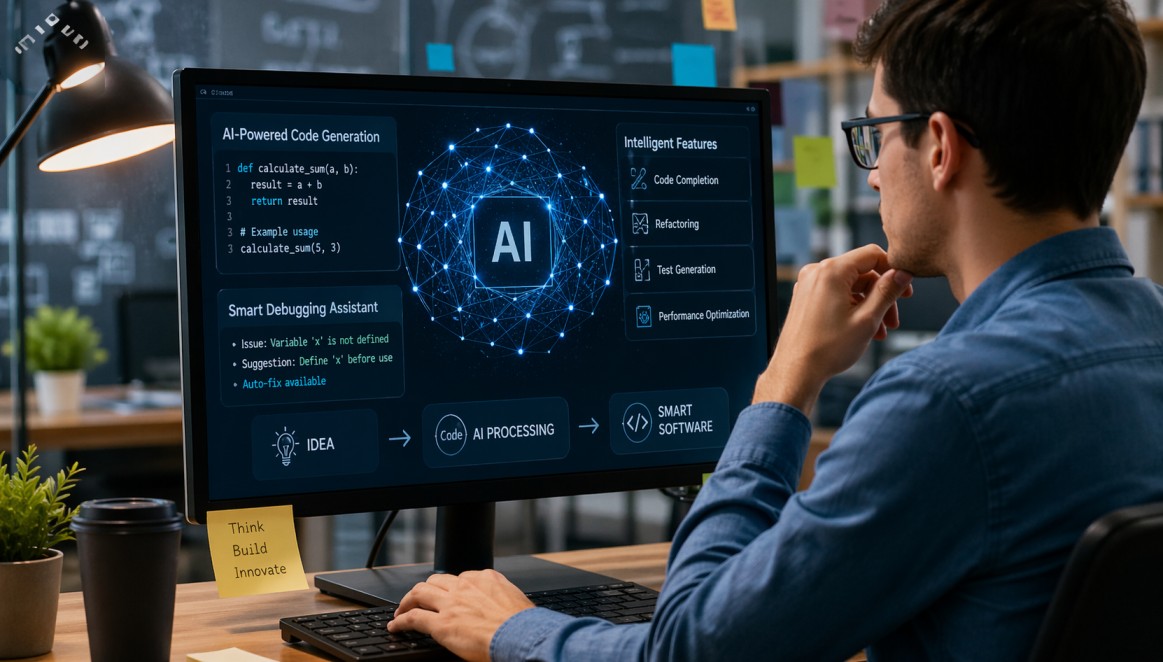
The Software Your Competitors Are Building Right Now Is Already Smarter Than Yours
There is a growing gap between businesses that treat software as a static tool and businesses that treat it as a living, intelligent system, one that learns, adapts, predicts, and acts on behalf of the organisation.
That gap is widening fast. In 2026, the most competitive businesses across financial services, healthcare, retail, logistics, and virtually every other sector are not just using AI as an add-on feature. They are building software with AI at its architectural core, systems that can understand context, reason about complex problems, automate multi-step decisions, and keep getting better with every interaction.
This is what next-gen AI software development means in practice. Not a chatbot bolted onto a legacy system. Not an AI feature announced in a press release but barely functional in production. Real, engineered, production-grade intelligent software, built with the right architecture from the ground up, deployed properly, and managed to keep performing over time.
This guide is for business leaders, product owners, CTOs, and anyone evaluating AI software development for their organisation. It explains clearly what next-generation AI software actually means, what the different categories of AI software are, how the development process works, what it can do for your business by industry, how to choose the right development partner, and what honest expectations look like on cost and timelines.
What “Next-Gen AI Software Development” Actually Means
The phrase “AI software” is used so loosely right now that it has almost lost meaning. Every product vendor claims their software is “AI-powered.” Every consultancy claims to build “intelligent solutions.” Most of it is marketing language applied to features that barely qualify.
So let’s be specific about what genuine next-generation AI software development means, and what separates it from the noise.
The Old Model: Software as a Set of Rules
Traditional software works by following rules written by developers. If a user does X, do Y. If a value exceeds a threshold, trigger an alert. If a form is submitted, validate the fields and write to the database.
This model works well for predictable, well-defined processes. But it breaks the moment something unexpected happens that the developer didn’t anticipate. It cannot generalise beyond its explicit programming. It cannot learn from experience. And it requires constant manual updates as business rules, data, and user behaviour evolve.
The New Model: Software That Learns, Reasons, and Acts
Next-generation AI software is built differently. Instead of executing fixed rules, it learns from data, reasons about context, makes probabilistic decisions, and in increasingly sophisticated deployments, acts autonomously to achieve defined goals.
The key technologies driving this shift in 2026 are:
Large Language Models (LLMs), Foundation models like GPT-4, Claude, Gemini, and Llama 3 that can understand and generate natural language, reason across complex inputs, write and review code, analyse documents, answer questions, and power conversational interfaces. When integrated into business software, LLMs enable capabilities that simply did not exist in software two years ago.
Generative AI, The broader category of AI systems that can generate new content, text, code, images, synthetic data, structured outputs, based on learned patterns and user instructions. Generative AI is being embedded into enterprise applications to automate knowledge work, accelerate content creation, power intelligent search, and enable AI-assisted decision-making at every level of the organisation.
Agentic AI, The next evolution beyond simple LLM integration. Agentic AI and intelligent automation systems can reason about goals, plan multi-step sequences of actions, use tools and APIs, make decisions, and execute tasks autonomously with minimal human oversight. These are not chatbots answering questions, they are autonomous agents completing complex workflows.
Machine Learning, Machine Learning Solutions gives trained models that predict outcomes, classify data, detect anomalies, and power intelligent features across virtually every type of business software.
Cloud-Native Architecture, Next-gen AI software is built for the cloud from the ground up, containerised, microservices-based, Engineering-Led Cloud Transformation, scalable, and deployable across hybrid and multi-cloud environments. This is the architectural foundation that makes intelligent applications scalable, resilient, and maintainable.
Multimodal AI, Systems that can understand and act on multiple types of input simultaneously text, images, audio, video, structured data enabling far richer and more contextual applications than text-only systems.
When these technologies are combined thoughtfully in a well-engineered software system, the result is software that doesn’t just execute instructions, it understands intent, learns from experience, and delivers genuinely intelligent outcomes.
The Main Categories of Next-Gen AI Software
Understanding the different types of intelligent software helps clarify what’s possible for your specific situation. Here are the main categories with plain-language explanations of each.
AI-Integrated Application Development
This is the most common entry point: taking a new or existing application and embedding AI capabilities that fundamentally change what it can do.
Examples of what this looks like in practice:
A customer service platform that previously required human agents to manually read and route tickets now uses an NLP model to understand the intent of each ticket, classify its urgency, route it to the right team, and draft a suggested response, all automatically before a human even sees it.
An e-commerce platform that previously showed users generic product listings now uses a real-time recommendation engine trained on purchase behaviour, browsing patterns, and contextual signals to surface personally relevant products for each individual user.
An enterprise document management system that previously required users to manually search through files now uses semantic search powered by an embedded LLM, understanding what users are looking for and returning contextually relevant results even when the exact words don’t match.
The underlying application architecture might be a web platform, a mobile app, an internal business system, or an API layer. The AI capabilities are engineered into the architecture from the start, not bolted on as an afterthought.
LLM Application Development
Building software that uses large language models as a core component is one of the fastest-growing areas of enterprise software development in 2026.
LLM applications include:
AI copilots, intelligent assistants embedded in enterprise software (CRM, ERP, project management, data analytics tools) that help users accomplish tasks faster. A sales copilot that drafts personalised outreach based on CRM data. A legal copilot that reviews contracts and flags non-standard clauses. A data copilot that answers natural language questions about your business data.
RAG (Retrieval-Augmented Generation) systems, applications that combine an LLM’s reasoning capability with access to your organisation’s specific knowledge base, internal documents, policies, product information, historical data. The result is an AI system that can answer questions accurately about your specific business context, not just general knowledge.
Intelligent document processing, systems that read, understand, extract, and act on information from unstructured documents at scale. Invoices, contracts, regulatory filings, clinical notes, insurance forms, documents that previously required human reading and manual data extraction can be processed automatically at high speed and accuracy.
AI-powered search and knowledge management, replacing keyword-based search with semantic search that understands what the user actually means and surfaces genuinely relevant results, even across large and complex knowledge bases.
Agentic AI Systems
Agentic AI and Intelligent Automation is the most ambitious category of next-gen software, and the one with the highest operational impact for businesses that deploy it well.
An AI agent is a software system that can pursue a goal autonomously. It can reason about what steps are needed, use tools and APIs to take actions, adapt its approach when something unexpected happens, and continue executing until the goal is achieved, without requiring a human to supervise every step.
A simple agent might handle a single, defined workflow: reading incoming supplier invoices, extracting the relevant data, matching against purchase orders, flagging discrepancies, and updating the ERP system, all without human involvement for standard cases.
A more sophisticated multi-agent system might coordinate multiple specialised agents working in parallel: one agent gathering market intelligence from external sources, one analysing your internal sales data, one generating a strategic report, and one distributing that report to the right stakeholders, all triggered by a single instruction.
The operational impact is significant. Businesses deploying our agentic systems typically achieve 70%+ reductions in manual processing time within 90 days of deployment and run those processes continuously, 24 hours a day, without fatigue or error accumulation.
Enterprise Software Modernisation with AI
A large proportion of today’s enterprise software challenges are rooted in legacy systems, monolithic applications built years or decades ago that are slow to change, expensive to maintain, brittle under load, and structurally incompatible with the AI capabilities businesses now need.
Modernising these systems doesn’t always mean replacing them entirely. A strategic modernisation approach typically involves decomposing the monolith into modern microservices, replacing or augmenting specific components where AI delivers clear value, building an API layer that enables integration with modern tools and data sources, and migrating to cloud-native infrastructure that supports scalability and resilience.
AI-led modernisation accelerates this process. Machine learning can analyse legacy codebases and map dependencies that would take developers months to trace manually. Generative AI can assist in re-engineering specific components. Automated testing frameworks validate that modernised components behave correctly before replacing the legacy equivalents.
The result is software that performs like a modern system, scalable, maintainable, AI-capable, built on the knowledge and domain logic embedded in your existing systems over years of operation.
Cloud-Native AI Platform Development
For businesses building new AI-powered products or internal platforms from scratch, cloud-native architecture is the only sensible starting point in 2026.
Hybrid and multi-cloud expertise AI platforms are built as collections of loosely coupled microservices, deployed in containers, orchestrated with tools like Kubernetes, and designed to scale horizontally on demand. They are API-first, enabling integration with any external service, data source, or consumer application. They include AI capabilities as first-class components, not optional add-ons.
The advantages over traditional monolithic architecture are substantial: each service can be developed, deployed, and scaled independently; AI components can be updated or replaced without touching the rest of the system; the platform scales automatically to handle demand spikes; and the entire system can run across multiple cloud environments for resilience and cost optimisation.
How Next-Gen AI Software Development Works, The Engineering Process
The most common concern businesses have when approaching AI software development is that the process feels opaque. What actually happens? In what order? How are decisions made? Here is a clear, honest walkthrough.
Phase 1: Discovery and Requirements Definition (Weeks 1–3)
Every successful AI software project starts with a clear, shared understanding of what is being built and why.
This phase involves structured workshops with your business stakeholders and technical leads to map the problem space in detail: What does the software need to do? Who are the users and what are their specific needs? What data does the system have access to and what quality is it? What does success look like, in measurable terms, not aspirational ones? What are the constraints (compliance requirements, integration dependencies, security requirements, performance thresholds)?
On the AI side, discovery also involves assessing which AI capabilities are genuinely appropriate for the problem. Not every feature benefits from AI. One of the most common and expensive mistakes in AI software development is using AI where simpler approaches would work better. A good engineering team identifies exactly where AI adds genuine value and where it doesn’t, and designs accordingly.
The output of this phase is a detailed technical specification and architecture proposal, the blueprint for everything that follows. Nothing gets built before this document is reviewed and agreed.
Phase 2: Architecture Design and Technology Selection (Weeks 2–4)
With requirements clear, the engineering team designs the system architecture. This means deciding:
Which AI models and frameworks are appropriate (fine-tuned open-source LLMs vs. API-based foundation models vs. custom ML models vs. combinations of all three), how data flows through the system, how AI components interact with non-AI components, what the API layer looks like, how the system handles edge cases and failures, what the security model is, how the system scales, and how it will be monitored in production.
Technology selection in AI software is genuinely consequential. The choice between a cloud-hosted LLM API (OpenAI, Anthropic, Google Gemini) and a self-hosted open-source model (Llama, Mistral) involves trade-offs on cost, latency, privacy, and customisability that affect every downstream decision. The choice between a microservices architecture and a more monolithic approach depends on team size, scale requirements, and long-term maintenance considerations.
These decisions are made deliberately, documented, and explained to your team, not made invisibly by engineers and presented as a fait accompli.
Phase 3: Agile Development in Sprints (Weeks 4–16+)
Development happens in two-week sprint cycles with working software demonstrated at the end of every sprint. This matters for AI software specifically because AI components often behave in ways that are difficult to fully anticipate at design time, seeing them working in a real interface with real data surfaces issues and refinements far earlier and cheaper than discovering them at the end of a long build phase.
Each sprint produces reviewed, tested, documented code. AI components are validated against defined performance metrics at every stage, not just at the end. Security scanning is automated and runs continuously throughout the build.
Your team has direct access to the lead engineer throughout. Weekly sprint reviews give you full visibility into progress, any issues, and upcoming work. There are no surprises at launch.
Phase 4: AI Model Integration and Validation
Integrating AI capabilities into a production software system is more complex than calling an API. It requires:
Prompt engineering, for LLM-based features, designing and testing the instruction sets that govern how the model behaves in specific contexts. This is both a technical and a product discipline, prompts that work well in one context can produce unexpected results in another.
Evaluation frameworks, systematic testing of AI component behaviour across hundreds or thousands of test cases, including edge cases, adversarial inputs, and variations in data quality. AI components must be proven to behave correctly and consistently before they touch production data.
Performance validation, verifying that AI-integrated features meet their defined performance thresholds: response latency, accuracy, throughput under load, and graceful degradation when AI services are unavailable.
Explainability and auditability, in regulated industries especially, ensuring that AI-driven decisions can be explained, logged, and audited. This is an architectural requirement, not a documentation exercise.
Phase 5: DevOps, CI/CD, and Production Deployment
Next-gen AI software is deployed through automated CI/CD pipelines, not manual release processes. Every code change is automatically tested, security scanned, and deployed to staging environments for validation before any change reaches production.
Containerisation with Docker and orchestration with Kubernetes means AI components can be deployed, scaled, and updated independently of the rest of the system. Infrastructure is managed as code, reproducible, version-controlled, and deployable to any environment.
Zero-downtime deployment strategies mean your users experience no service interruption during updates. Rollback capability means any problematic release can be reversed in minutes, not hours.
Post-launch, automated monitoring tracks application performance, AI component behaviour, error rates, and user experience metrics continuously. Our team receives alerts before issues affect users, not after.
Phase 6: Continuous Improvement and AI Model Maintenance
This is where most AI software projects either sustain their value or quietly lose it.
Data Analytics and Business Intelligence AI models are not static. Foundation models are updated by their providers. Your business data changes over time. User behaviour evolves. The inputs your AI system receives in six months will be different from the inputs it was trained or tested on. Without active monitoring and periodic model updates, AI software degrades, sometimes gradually, sometimes suddenly.
A mature next-gen AI software development practice includes ongoing model performance monitoring, scheduled evaluation reviews, and a clear process for updating AI components when performance changes. This isn’t optional maintenance, it’s what keeps intelligent software intelligent.
Next-Gen AI Software Development by Industry
The most useful way to understand what AI software development can deliver for your business is through specific industry examples. Here is how intelligent software is creating competitive advantage across the sectors where we work.
Financial Services
Financial services organisations face a unique combination of requirements: enormous data volumes, high-stakes decisions made at speed, strict regulatory frameworks, and intense competitive pressure from technology-native challengers.
AI-powered credit and risk platforms, intelligent underwriting systems that assess credit applications using a broader and more nuanced set of signals than traditional scoring models, making better risk decisions faster. These systems need to be explainable for regulatory reasons, a feature that is architected in from the start, not added later.
Intelligent fraud detection and prevention, real-time fraud scoring systems embedded in payment and transaction platforms that analyse hundreds of contextual signals simultaneously and make accept/reject/review decisions in milliseconds. Machine learning models trained on your specific transaction patterns consistently outperform generic rule-based approaches, catching more fraud with fewer false positives.
AI copilots for financial professionals, LLM-powered assistants that help analysts, relationship managers, and compliance officers work faster. Summarising research, drafting client communications, reviewing documents for regulatory compliance, generating reports from structured data, knowledge work that currently takes hours compressed into minutes.
Algorithmic compliance monitoring, systems that continuously monitor transactions, AI Cybersecurity Solutions, communications, and activities against regulatory requirements, flagging potential issues in real time rather than discovering them in periodic audits.
Compliance with FCA regulation in the UK and SEC/FINRA/CFTC rules in the US is built into every financial services AI system we engineer.
Healthcare and Life Sciences
Healthcare software has always been complex, the regulatory requirements are demanding, the data is highly sensitive, and the decisions made on the basis of software outputs can directly affect patient wellbeing. AI makes the capability ceiling significantly higher while also raising the stakes.
Clinical decision support systems, AI-integrated software that assists clinicians with diagnostic decisions, treatment pathway selection, and risk stratification. Systems that surface relevant research, flag potential drug interactions, or identify patients at elevated risk of specific outcomes, based on real-time analysis of patient data across multiple sources simultaneously.
Intelligent patient management platforms, applications that automate appointment scheduling, triage prioritisation, follow-up communications, and care pathway coordination. Administrative burden is one of the biggest challenges in healthcare, AI software can eliminate a significant proportion of it.
AI-powered medical imaging analysis tools, platforms that assist radiologists and other imaging specialists with anomaly detection and classification. Deep learning models embedded in clinical software can process images at scale and surface findings for human review, improving throughput without reducing accuracy.
Regulatory and compliance document processing, clinical trials generate enormous volumes of regulatory documentation. AI systems that can extract, classify, validate, and organise clinical data security dramatically reduce the time and cost of regulatory submission processes.
HIPAA compliance in the US and NHS data governance standards in the UK are non-negotiable requirements in every healthcare engagement.
Retail and E-Commerce
Retail is one of the most competitive environments in the world and one where intelligent software can deliver directly measurable commercial impact.
Personalisation and recommendation platforms, AI-native e-commerce platforms that deliver genuinely individual experiences to every visitor: product recommendations based on browsing and purchase history, personalised search results, dynamic homepage content, and individually targeted promotions. The commercial case is consistently compelling, higher average order values, better conversion rates, and improved customer retention.
Intelligent inventory and demand management systems, platforms that integrate with purchasing, warehousing, and sales data to predict demand at the SKU level and automate procurement, replenishment, and allocation decisions. The difference between good and poor demand prediction compounds across thousands of SKUs and millions in inventory value.
AI-powered customer service platforms, intelligent support systems that handle routine customer enquiries automatically (order status, returns, account changes), route complex cases to the right agents with full context, and assist human agents with suggested responses. Customer satisfaction typically improves because response times drop dramatically for standard requests.
Dynamic pricing engines, systems that continuously optimise prices across product lines based on demand signals, competitor pricing, margin requirements, and inventory levels, delivering margin improvements that static pricing cannot achieve.
Logistics and Supply Chain
Logistics is fundamentally a data-intensive optimization problem, matching capacity, routes, timings, and assets to demand in real time across complex, distributed networks. AI software solves this better than any human team or rule-based system can.
Intelligent route optimisation platforms, real-time routing systems that dynamically calculate the most efficient delivery routes accounting for traffic, delivery time windows, vehicle capacity, driver constraints, and fuel costs. At scale, the savings in fuel and vehicle utilisation are substantial.
Predictive maintenance platforms for fleet and equipment, systems that use sensor data from vehicles and machinery to predict maintenance requirements before failures occur, dramatically reducing unplanned downtime and extending asset life.
Supply chain visibility and risk platforms, AI-integrated systems that monitor signals across the entire supply chain in real time, supplier performance, geopolitical events, logistics disruptions, weather, and flag emerging risks before they become operational problems.
Warehouse management systems with AI, intelligent warehouse platforms that optimise picking, putaway, and inventory positioning using machine learning, and increasingly coordinate with robotic systems for physical automation.
Professional Services and Legal Tech
Professional services, legal, consulting, accounting, recruitment, are knowledge-intensive businesses where the most valuable asset is expert human judgment. AI software doesn’t replace that judgment; it removes the volume of lower-value work surrounding it.
Contract analysis and review platforms, LLM-powered systems that read and analyse contracts at speed, identifying non-standard clauses, flagging risks, comparing against defined positions, and producing structured summaries for human review. Work that takes a junior lawyer hours becomes a matter of minutes.
Intelligent knowledge management systems, platforms that make organisational knowledge genuinely accessible using semantic search and LLM-powered summarisation. Professionals spend a startling proportion of their time searching for information they know the organisation already has somewhere.
AI-assisted research and analysis tools, systems that gather, synthesise, and summarise information from multiple sources to support research-heavy work like due diligence, market analysis, and regulatory review.
How to Choose a Next-Gen AI Software Development Partner
The market for AI software development is crowded with firms making ambitious claims. Here is what actually matters when evaluating who to work with.
Production Track Record, Not Demo Capability
Building an impressive AI demo is relatively straightforward. Building production software, AI-integrated, running reliably 24 hours a day, handling real user load, integrated with real business systems, maintained and updated over time, is a different and substantially harder discipline.
Ask to see production deployments. Ask specifically about applications that have been live for more than six months. Ask what challenges arose in production and how they were resolved. A firm that can answer these questions concretely and honestly has the right experience. A firm that pivots to showing more demos does not.
Informatics360 has delivered 200+ software applications and platforms in production globally, with 99.95% average uptime across all live applications we manage.
Deep AI Engineering Capability Alongside Software Engineering
AI software requires two distinct skill sets working together: traditional software engineering (architecture, API design, testing, DevOps, security) and AI engineering (model selection, prompt engineering, evaluation, MLOps, AI observability). Firms that are strong on one and weak on the other consistently produce systems that either have poor AI performance or poor software quality.
Our team combines senior software engineers, AI engineers, data scientists, and DevOps specialists in a single integrated practice, every AI feature is built with the same engineering rigour as every other component.
Architectural Thinking, Not Feature Assembly
The difference between AI software that scales and AI software that creates technical debt is almost always architectural. A system built by assembling features without a coherent architectural vision, microservices bolted together without clear interfaces, AI components integrated without considering production monitoring, a data model that wasn’t designed for the queries being run against it, becomes increasingly difficult and expensive to maintain and extend.
Every Informatics360 engagement begins with a rigorous architecture design phase where the full system is designed before a line of code is written. Every design decision is documented and explained. The result is software that is genuinely maintainable and extendable, not just functional at launch.
Security and Compliance as Engineering Requirements
AI software introduces specific security considerations that traditional software frameworks don’t fully address. Prompt injection, malicious users crafting inputs designed to manipulate LLM behaviour. Data leakage, AI systems inadvertently surfacing sensitive information in responses. Model manipulation, adversarial inputs designed to cause incorrect predictions.
These aren’t theoretical risks. They are real attack vectors being actively exploited against AI systems in production. Every system we build includes AI-specific security controls alongside conventional application security.
A Partner Who Works With You, Not Around You
The best software is built when engineers and business stakeholders work as genuine partners. Your team understands the domain, the users, and the commercial requirements. Our team provides the engineering capability, architectural knowledge, and AI expertise. That combination, when it’s a genuine collaboration rather than a one-directional brief, is what produces software that actually works the way your business needs it to.
From the first discovery session through every sprint review to the post-launch support model, Informatics360 operates as an extension of your team, fully transparent, directly accessible, and genuinely invested in your outcomes.
UK and USA Presence, Local Knowledge, Global Delivery
Regulatory context matters significantly in AI software development. The EU AI Act, GDPR, and sector-specific UK regulations create specific engineering requirements for AI systems deployed in Europe. HIPAA, CCPA, and US financial regulations create different requirements for systems deployed in the US.
Our offices in London (Canary Wharf) and New Jersey mean our teams bring local regulatory knowledge to every engagement, not as a compliance afterthought but as an engineering input from day one.
Realistic Expectations, Costs, Timelines, and ROI
Being honest about what AI software development costs, how long it takes, and what returns to expect is something many firms in this space avoid. We don’t.
How Long Does AI Software Development Take?
A focused AI feature integration into an existing platform, a recommendation engine, an intelligent search layer, a document processing workflow, can typically be designed and deployed in 8–12 weeks.
A new cloud-native AI-integrated application built from scratch, with full architecture design, development, testing, and production deployment, typically takes 16–24 weeks for a medium-complexity product.
A large-scale enterprise platform modernisation or a complex agentic AI system might take six to twelve months, delivered in phases with working software available at each milestone.
Timelines are almost always compressed by starting with a well-scoped discovery phase. The clearer the requirements, the architecture, and the success criteria before development begins, the fewer surprises arise mid-build.
What Does AI Software Development Cost?
Costs depend significantly on scope, complexity, and the AI capabilities involved. The honest answer: a focused AI software engagement starts from tens of thousands. A major enterprise platform is a more significant investment.
What makes this investment worthwhile is the ROI calculation. Our clients typically achieve 60% reduction in time-to-market compared to traditional development, 3x faster feature delivery velocity post-launch, and direct commercial returns from AI capabilities, reduced operational costs, increased conversion rates, improved customer retention, or significant time savings on knowledge work.
We offer a free initial discovery session for any serious prospective engagement. This gives you a clear scope, timeline, and investment picture before any commitment, so you can make an informed decision based on a realistic ROI calculation for your specific situation.
What Returns Can You Realistically Expect?
The returns from next-gen AI software are most predictable when they are tied to specific, measurable outcomes defined before development starts.
If you’re building an AI system to automate a specific high-volume process, the ROI is calculable: current cost of running that process manually, minus the cost of the AI system including ongoing management, equals your return. Our agentic AI systems typically reduce manual processing time by 70%+ within 90 days.
If you’re building a personalisation and recommendation engine for e-commerce, the ROI is measurable in conversion rate improvement, average order value increase, and customer lifetime value. These are metrics you can baseline before launch and track rigorously after.
If you’re building an AI copilot for knowledge workers, the return is in the hours saved per worker per week, multiplied across your team.
In every case, the expectation should be set before development starts, not assumed after launch.
Why Informatics360 for Next-Gen AI Software Development
Informatics360 is a specialist AI software engineering firm. Here is specifically what makes our approach different and why businesses across the UK and USA choose us for next-generation AI software development.
We build for production from day one. Every application we deliver is built with production reliability as a non-negotiable requirement, not a goal to be achieved after launch. Our 99.95% average uptime across live managed applications is the result of architectural discipline, automated testing, and continuous monitoring, not luck.
200+ software applications and platforms successfully delivered globally. Across financial services, healthcare, retail, logistics, and technology. That track record means we’ve solved the hard problems, navigated the edge cases, and delivered at scale in the industries most relevant to your business.
We integrate the full spectrum of AI capabilities. LLM integration, generative AI, agentic AI, machine learning, NLP, computer vision, not as separate offerings from siloed teams, but as a unified AI engineering practice. Our Machine Learning Solutions,Agentic AI,NLP, and Next-Gen AI Software Development practices work as one integrated team.
Architecture-first engineering. Every engagement begins with a rigorous architecture design phase. Every design decision is deliberate, documented, and explained. The result is software that is genuinely maintainable and scalable over the long term, not just functional at launch day.
Security embedded from the ground up. AI-specific security controls, GDPR and HIPAA compliance where required, zero-trust architecture, and robust auditability are engineering requirements we address from the architecture phase, not compliance boxes ticked before launch. Our AI Cybersecurity Solutions practice is integrated into every software engagement.
Cloud-native expertise across all major platforms. Our hybrid and multi-cloud consulting and cloud migration expertise ensures every AI software system we build is deployed in the right environment, AWS, Azure, Google Cloud, or hybrid, optimised for performance, cost, and compliance.
We are a genuine partner, not a vendor. Weekly sprint reviews. Direct access to your lead engineer. Full transparency on progress, decisions, and challenges. A shared accountability for outcomes, not just a handover of deliverables.
UK and USA based. With offices in London and New Jersey, we bring local regulatory knowledge, time-zone aligned communication, and a genuine understanding of the markets in which our clients operate.
Frequently Asked Questions About Next-Gen AI Software Development
What is the difference between AI software development and traditional software development?
Traditional software executes fixed, rules-based logic written by developers. AI software learns from data, reasons about context, and makes probabilistic decisions, enabling capabilities that cannot be achieved with fixed rules. The engineering discipline overlaps significantly, but AI software requires additional expertise in model selection, prompt engineering, AI evaluation frameworks, MLOps, and AI-specific security. Next-gen AI software combines these disciplines fully, every AI feature is engineered with the same rigour as every other component.
Do I need to replace my existing systems to adopt AI software?
Not necessarily. Many AI capabilities can be integrated into existing applications through APIs and modular architecture. Legacy systems that are genuinely incompatible with modern AI integration may benefit from a modernisation approach, but this is assessed case by case, not assumed. A good engineering partner will tell you honestly what’s possible within your existing architecture and where modernisation genuinely makes sense.
What data do I need to build AI-powered software?
It depends on the AI capability. LLM-powered features (intelligent search, document processing, copilot functionality) draw on foundation models that don’t require your data for training, they need good prompt engineering and a well-structured integration. Machine learning features (personalisation, fraud detection, demand forecasting) require historical training data of sufficient volume and quality. Agentic systems require well-defined workflows and access to the systems and data sources the agents need to act on. A discovery session will clarify your data readiness for specific capabilities.
How do you ensure AI software is secure and compliant?
Security and compliance are engineering requirements we address from the architecture design phase. This includes AI-specific controls (prompt injection protection, output filtering, data access controls), conventional application security (authentication, authorisation, encryption, penetration testing), and regulatory compliance controls (GDPR data handling, HIPAA requirements, audit logging for regulated industries). We do not treat these as finishing steps, they are inputs to every design decision.
Can you integrate with our existing systems and data?
Yes. API-first architecture means our software is designed to integrate with your existing systems, CRM, ERP, databases, cloud services, third-party APIs, from the outset. Integration requirements are mapped in detail during the discovery phase and architectured into the system design before development begins.
What happens after the software is launched?
We provide post-launch managed engineering support including application monitoring, performance optimisation, security updates, AI model performance monitoring, and ongoing development. Software that is launched and left unmanaged degrades over time, both in conventional reliability terms and in AI performance terms. Our post-launch service ensures your system keeps performing and keeps improving.
We are a small or mid-sized business, is this relevant to us?
Yes. Many of the highest-ROI AI software use cases are not enterprise-scale. A focused AI integration into a specific part of your operation, automating a high-volume process, adding intelligent search to a customer-facing product, building a document processing workflow, is achievable at a scale and cost appropriate for a growing business. The first step is understanding what’s possible for your specific situation, which is why we offer a free initial discovery session.
The Question Isn’t Whether to Build Intelligent Software. It’s Whether You Build It Well.
In 2026, the capability gap between businesses running intelligent, AI-integrated software and businesses running traditional rule-based systems is growing measurably. It shows up in operational efficiency, product quality, customer experience, and decision-making speed.
The good news is that next-gen AI software development is more accessible than ever, to businesses of all sizes, across all sectors. The right approach is a realistic assessment of where AI creates genuine value in your specific situation, a clear scope and success criteria, and a development partner with the engineering depth to build something that works in production, not just in a demo.
That is exactly what Informatics360 delivers.
Ready to build software that thinks? Start with a free discovery session →